Monday, October 27, 2008

test

test

Sunday, May 28, 2006

change of blog imminent

If you subscribe to this blog through RSS feed you might get to read this. But I don't think you'll receive it by visiting this blog at http://billkerr.blogspot.com/. But then, you won't know that I'm saying that, will you.

My advice to any blogger users reading this is to immediately backup your blog.

I did this successfully recently. The instructions are here and they worked for me.

I wrote to blogger support yesterday but given the nature of blogger (google free service) I'm not really expecting a response in the next 2 years. It's hard to "do no evil" when you have several billion customers who are all in a hurry.

I've enjoyed using blogger because you can tweak the HTML, unlike Wordpress.

Where will I go? Maybe to ourmedia. I like their philosophy a lot. But I'm still deciding. Catch you in cyberspace, somewhere...
farewell

Here's the mail:
006 Please contact Blogger Support.blog/63/54/2/billkerr/index.html

My latest post (May 27) can be viewed from the specific post URL
http://billkerr.blogspot.com/2006/05/instructional-software-design-project.html

but it CAN'T be viewed at
http://billkerr.blogspot.com/

The most recent post that can be viewed there is an earlier one (May 17)

When I uploaded the post I received this error message:
getLinkByTarget("_blogview") has no properties

I get the same error message if I try again or even if I upload and then delete a test post

New posts are listed and can be edited on this screen:
http://www.blogger.com/posts.g?blogID=10936863

and they are fed through this RSS feed
http://billkerr.blogspot.com/atom.xml
when viewed through bloglines
(but I get an error when I paste the RSS URL directly into my browser)

I am using the latest version of firefox for browsing

any help would be much appreciated
thankyou,

Saturday, May 27, 2006

instructional software design project

I submitted the following article to the Australian Maths Teacher Journal in 1994 but it was rejected for publication. The note I received back said that my students hadn't really achieved much learning in Fractions.

I still think this was a very worthwhile Project and that the reviewer didn't take into account all of the meta-learning that happened. The approach used is still relevant today but it does require a high skill level for the teacher in a variety of areas - programming skills and managing a complex learning environment.

The article also includes a comprehensive explanation of the "instructional software design project" approach which was pioneered by Idit Harel and Seymour Papert and which still draws positive reviews today.

Anyway, the era of paper journals is over. I can publish what I want. You, the reader can ignore, critique or praise.

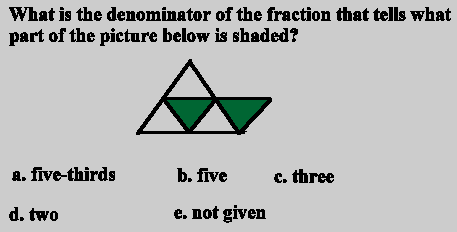
frac2

Education Software: Designed by Kids, for Kids
- link to full article written by Bill Kerr in 1994
Abstract
Students at the Year 8 level used LogoWriter software to design computer screens to teach Year 3/4 students Fractions. Students were set the task of doing transformations between words, symbols and pictures using LogoWriter. They recorded their experiences in a journal and identified problems they encountered and solutions to those problems. They helped each other solve problems in Fractions, design and computer programming.

Outcomes from this learning sequence included expressive writing about mathematics, improved scores in a Fraction test, improved fluency in Logo programming, improved self management skills, increased cognitive resilience (overcoming frustration and not giving up), improved time management, and increased faith by the students in their own thinking patterns. Students remained motivated and interested in the Fractions topic for a 7 week block using this approach. The culture of mathematics was perceived by the students to be different and more interesting than traditional textbook maths. Some students dropped in at recess and lunch to work on their projects.

The final combined software product is a useful piece of educational software that can be utilised by other teachers for diagnostic purposes as well as being an exemplar of what can be achieved with LogoWriter when it is used in this way.
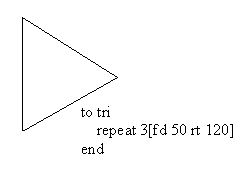
triProcedure

Conclusion

Teachers face the task everyday of how to make their subjects relevant and interesting to their students and this is seen to be a particular problem with maths. One way to look at this is from the point of view of objects to think with. The teacher and students co-construct a learning environment that is replete with "objects to think with". These "objects" include:
  • The challenge of teaching others and designing screens for this purpose using Logowriter
  • The structure of fractions and their transformations (words, symbols, pictures)
  • Other students, eg. best friends, class experts, the Year 3/4 students
  • Teacher (Is he/ she approachable, friendly and skilled?)
  • Journal reflections
Taken together these objects represent the ISDP (Instructional Software Design Project)

Harel and Papert (1990) argue that some materials are better with regard to the following criteria:
  • appropriability (some things lend themselves better than others to being made one's own)
  • evocativeness (some materials are more apt than others to precipitate personal thought)
  • integration (some materials are better carriers of multiple meaning and multiple concepts)
When used in the way described above LogoWriter is a most effective learning medium to think about Fractions and Design according to these criteria.

Wednesday, May 17, 2006

probing naive understandings of computing concepts

Albert Einstein, when asked to describe radio, replied:
"You see, wire telegraph is a kind of a very, very long cat. You pull his tail in New York and his head is meowing in Los Angeles. Do you understand this? And radio operates exactly the same way: you send signals here, they receive them there. The only difference is that there is no cat."
Dr. Paul Chandler has created a wiki about probing naive understandings of computing concepts.

He writes:
Over the last couple of years, I've been turning an idea around in my mind; it's basically seeking to better understand "how students understand computing concepts". For those who might know of "children's science" in the area of science teaching, the idea is to apply the same sorts of ideas to the understanding of computing concepts (and yes, I am deliberately using 'computing' rather than IT or ICT). Another way to put it would be to 'probe the naïve understandings of computing'.
This was of great interest to me because when I was a science teacher I used the New Zealand Unversity of Waikato Learning in Science Materials. They had developed whole units of work (electricity, force etc.) which would start by teasing out existing viewpoints held by children and build on that. I thought they were brilliant.

WRT computing I also think it would be valuable from the perspective that some teachers seem to believe that their students know more than they do.

It's also an issue for me because of the new part of my job: teaching new arrivals, many from Africa, basic computing skills.

I've written a few entries to this wiki and have been following the interesting conversation between Paul and Tony Forster about whether or not immersion is the simple answer to this question.

Amongst other things, I raised the issue of file extensions, that they provide meaningful and important information and yet they are hidden by default in Windows systems. Once again there is interesting discussion about this topic.

I hope to see you at Paul's wiki.

Tuesday, May 16, 2006

politically incorrect

wright0508
This cartoon does cut the mustard.

I stuck it up at school and there was agreement that it was funny, except for one wry comment: "Not funny, it's too close to the bone"

google index size

Google used to publish their index size on their main page but stopped some time ago

However, you can still find out by this search: * *

The google index currently contains 25,270,000,000 pages

Informative article about google here

censorware and fascism connection

Although we are opposed in theory to fascist dictatorships we treat our children AND TEACHERS at school in a similar way to which a fascist dictatorship treats its citizens, eg China
tiananmen

Great article on censorware by seth Finkelstein at http://blog.outer-court.com/archive/2006-05-15-n66.html

3. Censorware often blacklists language translation sites, as a LOOPHOLE

Too much of the discussion about censorware takes place in terms of the misnomer “filtering”. That conjures up an image of removing evil, yucky, even toxic material, while leaving a purified result. The constant chant of “porn, pornography, harmful to minors, obscenity, child porn, pr0n, porno, PORN ...” often keeps issues framed in these terms. People sometimes gets the idea that censorware is intended to remove evil sites. No. It is designed to control what people are permitted to read. That is a very different problem. It implies that even if there was a perfect blacklist for sex or other prohibited material, censorware would still need to ban anonymity, privacy, language translation sites and more. Because all such sites, no matter how functional and useful they may be, have the capability to allow a reader to view any other site. They are a LOOPHOLE.
and
7. If censorware works for parents to control children in the US, it’ll work for governments to control citizens in e.g. China. Contrariwise, if censorware can’t work for governments to control citizens in e.g. China, it can’t work for parents to control children in the US.

Many discussions of censorware tend to revolve around statements of values, usually concerning which authorities have legitimate rights of control, in what contexts. Typically the values are that parents have a right to prohibit their children from reading certain materials, employers can control what employees view, but governments should not censor citizen’s ability to obtain information. However, the technical implications here are essentially identical, no matter what the social relationships.

So there’s a deep problem in efforts to bypass Internet censorship. If citizens can escape from government control, then children can escape from parent’s control. But if restricting information works on minors in the US, it’ll work on citizens under dictatorial governments. Either way, the results are problematic.

Wednesday, April 26, 2006

Brewster's dream

knowledge
Brewster, would you like to share your dreams about Universal Access to Human Knowledge?

When I grew up I felt that life was happening to me - I got to watch TV, I heard from teachers, I read textbooks ... the newspapers were written by someone other ... it felt like things happened to me

It was only when I got to a technical college that I found people in the front end of a field ... it was very exciting, invigorating ... people answering questions that hadn't been answered, rather than, "Do it right kid, or you'll get a B"

It was exciting when I was in a crypto class and the teacher said, "In this class you're going to learn all these things ... and then we have a bunch of unanswered questions ... if you have any ideas on these unanswered questions, here's my home number" ... that's exciting!

The opportunity we have with the net and it's already happening is making it so that more people feel like they're at the front edge, that they're seeing primary materials, that they can talk and interact with the real guys, that they're building and making something new, that they have something to say that matters ... that the world is theirs to play with and build on.

The key thing for us is to make it Read / Write. You can read or comment or make something new. You deserve to be in the library too.

The key to happiness for me is satisfaction and being satisfied comes from doing things for others, that I could tell what their reaction was. One of the cool things about this WAIS system was you put up these things and you started to see the usage logs ... people were coming in from other countries ... they cared about me ... it was like that ham radio experience ... where are you?

We started to share things, making it so more people are on the front edge ... they are able to draw from the past and make new things

The downside, the evil, awful, how could it go wrong is cable television or DRM, where it's all locked up. You're allowed to experience it ... entertainment and being a consumer ... this is SICK, I don't want to be a consumer, I don't want to be entertained. That's happening to me. I want to be able to build on and show off to my friends ... and that requires easing up and being able to play with stuff.

I think ideas come from the commons. They're exploited successfully by Companies as Marx said ... but I'm a card carrying capitalist and I've been fairly successful. But I do know the limitations of what we can do in the private sphere.

The public sphere is something we really have to nurture. When I was first at an internet conference after coming out with WAIS in 1991, I remember putting up my hand and saying, "I'm the token dot com in the room, I'm here to help people make money on the net". But NOW, I'm the token dot org in the room! It's gone so far the other way that we've forgotten that it really requires the commons ...

That's my dream and hope that my kids have a better life than I have
- extract from mp3, Universal Access to All Knowledge, Brewster Kahle, 1:10 - 1:14

The whole audio presentation is very good. Brewster answers these questions clearly: Should we? Can we? May we? Will we? By taking the long term view of universal access to all knowledge as an achievable and worthy goal the problems raised by copyright law seem to become narrow and petty (my interpretation). There are a lot of questions at the end of the main presentation. Brewster Kahle is the founder of the internet archive.

Tuesday, April 25, 2006

blogswana

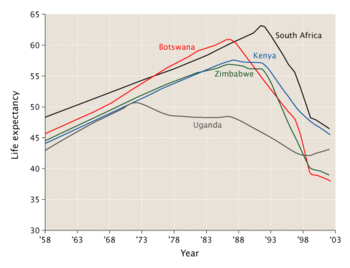
350px-Aids_in_africa_graph

blogswana: Botswana, AIDS and Blogging

The initial blog entry (April 7, 2006) by Curt Hopkins and Brian Schwartz launching this project is inspirational and informative.

Curt Hopkins:
Blogging for Others ... develop a program in each country that would send people out to blog for people who could not do it themselves ...

... they would create a blog for someone, say a farmer in a remote village who had neither the money for the hardware, nor the expertise, nor perhaps the time or literacy, to blog himself, or to an urban prostitute, or a nurse in an AIDS hospice, or a politician, or a minister. They would go out, at least once a month, interview this person, maybe take photos, video or audio, return to their computer and blog for this person. They would take the comments and questions out to the person the next time they went out

... The one-year pilot project will work with a group of about 20 college students from one of the major universities, and provide them with blogging and journalism expertise and guidance. They would commit to a year of “blogging for others.” Each student participant would start their own blog, as well as a blog for their “partner” (the person for whom they will blog). Each partner would be someone who has been effected in some way by the AIDS virus...

... By blogging about a person first, the disease will be seen again, we hope, in terms of its human context. AIDS in Africa is, for many in the west, a combination of statistics and abstract tragedy ...

T032032A
Brian Schartz:
...

It is our desire to create a rich, interesting site about the daily lives of Batswana. The public awareness and education campaigns are doing a great deal to make this problem a part of the national consciousness. Organizations such as the Botswana Network of People Living with HIV/AIDS (BONEPWA) are working to reduce discrimination against and the stigma attached to people living with aids. We would like to add to the public awareness and hopefully to help reduce the stigmatization of infected individuals.

My experience with Tswana culture leads me to believe that an approach that combined honesty with discretion could be quite effective. There are some things that are discussed in Tswana culture with a great deal of circumspection. For example, nobody ‘dies’ in Botwsana but people do ‘pass’. We want to raise public awareness discretely, we want risky behavior, decision to get tested, living with HIV/AIDS, etc. to be a part of these blogs but only insomuch as they relate to an individual with other concerns. We want the discrete language that the ordinary Batswana uses to be used in these blogs.

Being confronted with a world in which you either have it or you don’t (or you don’t know) must feel overwhelming to some people. We would like to create a blog site in which the reader is informed, not bludgeoned. We would like the blogs to be about the ordinary men and women of Botswana with the same concerns, hopes and dreams as the viewer. Some of these concerns will undoubtedly have to do with HIV/AIDS, but such concerns will not make up the entirety of the blogs. Reading about a sympathetic individual who is wrestling with an AIDS related issue may help the reader to come to terms with a similar issue themselves.

There is a saying in Setswana that I have adopted as part of my life. “Boiteko ke boikone.” Trying is success. I believe that our project could be part of the solution to this crisis that plagues Botswana. I believe that our efforts will, at the very least, get our 20 bloggers to consider more fully the HIV/AIDS problem in Botswana and their attitudes towards it.

Tags:

Sunday, April 23, 2006

property versus ideas

cc.logo.circle
When property meets ideas, which will prevail?
If nature has made any one thing less susceptible than all others of exclusive property, it is the action of the thinking power called an idea, which an individual may exclusively possess as long as he keeps it to himself; but the moment it is divulged, it forces itself into the possession of everyone, and the receiver cannot dispossess himself of it. Its peculiar character, too, is that no one possesses the less, because every other possesses the whole of it. He who receives an idea from me, receives instruction himself without lessening mine; as he who lights his taper at mine, receives light without darkening me. That ideas should freely spread from one to another over the globe, for the moral and mutual instruction of man, and improvement of his condition, seems to have been peculiarly and benevolently designed by nature, when she made them, like fire, expansible over all space, without lessening their density at any point, and like the air in which we breathe, move, and have our physical being, incapable of confinement or exclusive appropriation. Inventions then cannot, in nature, be a subject of property.
--Thomas Jefferson

quoted in The Economy of Ideas by John Perry Barlow
http://homes.eff.org/~barlow/EconomyOfIdeas.html

Saturday, April 22, 2006

cutting up a map

I've been working on cutting up a map of Africa into 54 pieces using GIMP tools, which I sort of know but not perfectly.

Initially it was slow going ... but I refined the technique wrote a GIMP tutorial about it today. I can use this as a classroom exercise in general and it might be a good way to teach African students GIMP techniques.

This is part of a wider project to make a game about Africa.
Tags:

Thursday, April 20, 2006

the free future and the tortuous present

transition
I'm a slow digital immigrant and Cory Doctorow is a very fast native / talker. He is a very powerful, articulate and rapid speaker. He went at 100mph with good jokes thrown in too. He spoke about Digital Rights Management - "what technology gives, technology takes away". The latest legal and technological moves and counter moves.

His general line was that DRM was a lousy business model because it criminalises the population, pisses off customers, does not work very well technically, is bad science (avoids critical scrutiny by legal means) and doesn't stop copying anyway.

But something was missing. He was stuck in the present talking about business model wars. That the copyfighters had a very bad model. That creative commons (release electronic copy for free at the same time as publishing hard copy for money) was a much better model.

After thinking about Cory's Melbourne talk my question for him is this:

You are a science fiction writer. You imagine futures in some detail. What you imagine about the future comes from somewhere. It comes from the present. You observe things in the present, pick up on some ideas and trends and exptrapolate those into the future. You write about futures where there is no material want, where immortality is a practical possibility and the main human struggle centres around reputation (wuffie). Your future has wings. Call this State B.

You are an EFF (Electronic Frontier Foundation) and DRM (Digital Rights Management) activist. This situates you very much in the present and you are aware in exquisite detail of the legal and technical situation of the current intense battle between those who want freedom and those who stand for reaction. This is a tortuous and painful nitty gritty struggle of attrition. The present is a grind. Call this state A.

How are we going to get from State A to State B?

Africa puzzle game

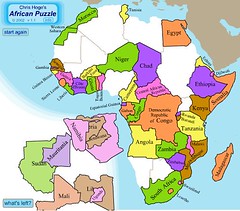
Africa Puzzle game by Chris Hoges. You start with a map of Africa showing the country names. Then when you click a button some of the countries are removed off the map and you have to put them back correctly

There are 5 levels of difficulty: variables are the number of countries removed from the map, whether the names are shown on the countries or not and whether a template showing the shape of the countries is shown or not

easiest - names shown, template shown, only a few countries removed from map
easy - names shown, template shown, more countries removed from map
medium - names shown, template shown, all countries removed from map
hard - names shown, template not shown, all countries removed from map
hardest - names not shown, template not shown, all countries removed from map

hogesAfricaPuzzle

The screenshot shows an easiest level game: names shown, template shown, only a few countries removed from the map

I really like this game because the different levels allow you to gradually learn the names, shape and location of the countries.

Wednesday, April 19, 2006

the wealth of networks

benklerC

The Wealth of Networks (html version) is a new book by Yochai Benkler, a Professor of Law at Yale Law School. HTML repository is here.

I have great admiration for Lawrence Lessig for his prolonged campaign to help build a free culture and he has given this book a tremendous rap:
This is — by far — the most important and powerful book written in the fields that matter most to me in the last ten years. If there is one book you read this year, it should be this. The book has a wiki; it can be downloaded as a pdf for free under a Creative Commons license; or it can be bought at places like Amazon.

Read it. Understand it. You are not serious about these issues — on either side of these debates — unless you have read this book.

The debate has already begun about the book at Lessig's blog.

Seth Finkelstein says it is written in academic language and deconstructs and parodies the language and message, "a little mouse can be heard if a big elephant trumpets him"

Lessig concedes that it is an academic work but says it is well worth the effort for its contribution to an important debate which spans law, economics and social theory.

Seth continues his critique of the standard blog evangelism in the book, that blogging does marginally improve democracy but the z-listers are fooling themselves and shouting in the wind. He follows up with, "punditry is not democracy" and that "Popularity Data-Mining Businesses Are Not A Model For Civil Society"

3blindmice accuse Benkler of merging the distinction between information production and information distribution and argue that copyright remains necessary for information distribution.In one entry they accuse Benkler of marxist kum-bah-yah, the tyranny of mob rule and marshall mcluhan reasoning.

ACS argues that the internet has created an environment where a mixture of pleasure and altruism generates the "survival of the most popular" and this is not as good as our present regime of "survival of the fittest" created by a disciplined commercial approach.

So will I get the book? I think I must. Despite and because of the discontents at his blog, the Lessig endorsement is still good enough for me, although I am a bit put off by the academic nature of the work. 3blindmice and ACS strike me as too clever by half conservatives not willing to contemplate a radical transformation of society. Seth Finkelstein is much more interesting (prodigious anti censorware work and essays) and so I plan to study some of his work too. Here is an interview with Seth and here is his blog.

The first paragraph of the final Part 3 of Benkler's book:
Part 3: Policies of Freedom at a Moment of Transformation
Part I of this book offers a descriptive, progressive account of emerging patterns of nonmarket individual and cooperative social behavior, and an analysis of why these patterns are internally sustainable and increase information economy productivity. Part II combines descriptive and normative analysis to claim that these emerging practices offer defined improvements in autonomy, democratic discourse, cultural creation, and justice. I have noted periodically, however, that the descriptions of emerging social practices and the analysis of their potential by no means imply that these changes will necessarily become stable or provide the benefits I ascribe them. They are not a deterministic consequence of the adoption of networked computers as core tools of information production and exchange. There is no inevitable historical force that drives the technological-economic moment toward an open, diverse, liberal equilibrium. If the transformation I describe actually generalizes and stabilizes, it could lead to substantial redistribution of power and money. The twentieth-century industrial producers of information, culture, and communications—like Hollywood, the recording industry, and some of the telecommunications giants—stand to lose much. The winners would be a combination of the widely diffuse population of individuals around the globe and the firms or other toolmakers and platform providers who supply these newly capable individuals with the context for participating in the networked information economy. None of the industrial giants of yore are taking this threat lying down. Technology will not overcome their resistance through an insurmountable progressive impulse of history. The reorganization of production and the advances it can bring in freedom and justice will emerge only as a result of social practices and political actions that successfully resist efforts to regulate the emergence of the networked information economy in order to minimize its impact on the incumbents.
- http://www.benkler.org/wealth_of_networks/Benkler_Final_Usable_Text.html

which wiki?

http://www.wikimatrix.org/ offers a useful service by which you can choose and compare the wikis on offer. There are 45 wikis to choose from on their sidebar.

They have a choice wizard, which I used to obtain a short list. The choice issues raised by the wizard were:
(1) History
A page history is a very basic feature but not available in all Wikis. When available, every time a page is edited the old version of the document is kept. People can later go back to an older revision and restore it if needed.

A page history is crucial for publicly editable Wikis to ensure that spam and vandalism can be reverted. For private or personal Wikis this may not be necessary.

I chose Yes. This was a very easy decision for me since I wanted a publicly editable wiki.
(2) WYSIWYG
Most Wikis use a simple markup language to format texts, but recently some Wikis introduced real WYSIWYG editors as known from desktop text processors.

On the one hand WYSIWIG editors make it very easy for non-tech savvy users to contribute. On the other hand experienced users often prefer a simple markup for its greater flexibility and faster text entry.

I chose Yes, since I wanted to make things as easy as possible for non-tech savvy users.
(3) Software or hosted?
You can either set up your Wiki software on your own hardware or you can simply subscribe to a hosted service on the Internet which will run the Wiki for you.

Running your own software installation gives you more control over the Wiki, but you may need to fulfill some requirements to do so.

When you go for the hosted option, you don't have to fiddle with any software installation, but you are restricted to what the service offers.

I chose hosted. I don't have access to my own server and I'm not a techie (confession) so I prefer the convenience of a hosted service.
(4) Your Own Domain?
Most Wiki hosting services provide either a subdomain in the form http://.wikihosting.com or a subdirectory like http://www.wikihosting.com/. If you like to run a Wiki for your business you may want to use your own domain.

Should using your own domain be supported?

I chose No because I'm looking for something that school students can also use.
(5) Corporate Branding
Some Wiki hosters allow to change how the Wiki looks like. This is important if you like the Wiki to match your corporate identity or if you plan to integrate the Wiki into an existing web presence.

Do you need corporate branding?

I chose No. Although I like css and setting up a new look might be important in the future this is not a big consideration for me at this stage.

This process narrowed down my choice to CentralDesktop, JotSpot, Socialtext, StikiPad and Wikispaces. I was then offered a Compare Them link which took me to a Wiki Feature Comparison chart, which compared the wikis against over one hundred different features. This final step of the process was more difficult for me because there was so much to look at. Free version and storage quota were important considerations but word of mouth played a decisive part in the final analysis since rigorously checking through a 100x5 grid is not really my cup of tea.

In the first place I noticed that Sean Fitzgerald was using wikispaces so he was voting with his feet, then when I posted my query at my blog, fellow SA blogger Graham Wegner recommended it along with pbwiki and then Leigh further supported wikispaces in response to my query in this thread. Word of mouth from trusted peers is very powerful.

I chose Wikispaces partly because others had recommended in comments to a previous blog entry and on the TALO list.

The wiki I have set up is http://africagame.wikispaces.com/

Wikispaces has a visual display of their main features here I have already used most of these features and they work just fine. The only feature which I would like to see change is to not provide the http:// starter for their external links, since I always cut and paste external links, so, I have to remember to go back and remove the http:// from the cut and paste.

UPDATE 3oth April
http://www.wikispaces.com/site/for/teachers
This is the address for Wikispaces for K-12 education use that is completely free, and free of advertising. You have to know about this, it is not available from their main page.
Tags:

Tuesday, April 18, 2006

africa game wiki

I have created a wiki for a computer game about africa and am looking for ideas and help.

Please visit the wiki and join if interested. I have received a lot of supportive and helpful email and half a dozen people have joined up.

Sunday, April 16, 2006

computer game about Africa

I am looking for people to help me make an educational computer game about Africa.

With the recent arrival of many African refugees in Australia this project could have a topical, humanitarian and political significance. It could also be fun. One of my goals at the outset is to do this as part of a group.

You may not be a programmer but can still help at the generation of ideas, design, sprites, music selection, testing and evaluation stages. If you are a programmer then you can either help me program it in Game Maker or consider another implementation in your preferred language.

Preliminary thoughts are here

I am very much in the initial stages, it seems appropriate to invite others to join a group at the start.

email: billkerr at gmail dot com

Send me email or leave a comment if you are interested in helping. I will be setting up a wiki for this project soon.

--
Bill Kerr
http://billkerr.blogspot.com/
http://beam.to/billkerr
skype: billkerr2006

Saturday, April 15, 2006

the dell theory of conflict prevention

The comment that "no two nations having McDonald's have gone to war" was put forward by Thomas Friedman in an earlier book, The Lexus and the Olive Tree. In Ch. 12 of The World is Flat he updates this slogan to "the Dell theory of Conflict Prevention"
world
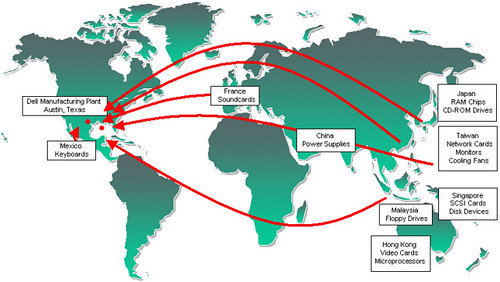
Friedman wrote his book on a Dell notebook. On an average day Dell sells 150,000 computers. As part of his research he asked Dell to trace the entire global supply chain that produced his notebook.

The answer to that question takes several pages and names lots of countries and companies.

To be a country which is part of such global supply chain is a powerful incentive not to go to war.

Friedman cites two instances in support of his Dell theory: India-Pakistan in 2002 (even though only India is part of the global supply chain) and China-Taiwan in 2004. In the book he gives quite a lot of supportive detail here.

Friedman is not talking in absolutes (war is still possible) but he argues that economic globalisation is acting as a powerful deterrent to war in those countries that are part of the global supply chain. The risks and consequences of being identified as an unstable country and having investment dollars withdrawn and businesses relocated are high.

Which countries are not part of the global supply chain: Iraq, Syria, South Lebanon, North Korea, Pakistan, Afghanistan and Iran.

Friedman then goes on to describe mutant global supply chains, with the al-Quaeda network in mind. He describes how al-Quaeda uses globalisation, the Internet, global media in a way to promote their cause. The jihadist identity has been globalised (jihadists in Iraq identify with the Bali bombing) and so have feelings of humiliation that the Muslim world is not doing as well as other worlds - Hindus, Jews, Christians, Chinese

He then draws a parallel between the global supply chain of manufactured goods in the West with a global supply chain of suicide bombers organised by al-Quaeda:
Just as you take an item off the shelf in a discount store in Birmingham and another one is immediately make in Beijing, so the retailers of suicide deploy a human bomber in Baghdad and another one is immediately recruited and indocrinated in Beirut
Globalisation is an irreversible and positive trend. We can't stop al-Quaeda using the internet and their terrorist beheading video tapes. The only answer is to modernise those countries that are not yet part of the global supply chain, that is, to drain the swamp that breeds terrorism.

my new game: Africa

afr
Last week I won a 0.2 teaching position at my school in working with new arrivals (mainly from Africa) in improving their ICT skills. This is in addition to my other roles of teaching year 11, 10 and 9 computing and Chess. So essentially I am back on a full load of five lines, although nominally 0.8, because Chess is off line without a full subject teaching load status, even though I am offering it as a SACE Unit (South Australian edu-speak jargon)

This semester my Year 11 course is about Game Design and Making and after a term of skill building we are just starting the design and make your own game part of the course.

So, I thought I'd combine my new role and my established programme by designing and making an educational game about Africa!

In this way I could both improve my knowledge of the countries and conditions my African students originate from as well as modelling for my year 11s the process of designing and making a game myself.

Since I have asked my year 11s to work in groups then I should try to do the group thing myself. I'm thinking that I should setup a wiki and invite others to contribute ideas towards this African game project. I'm currently uncertain about which wiki to use so am seeking advice about that.

Here are my current answers (they will certainly change) to the same four questions that I've asked my year 11s.

Name of your game?
  • Curious about Africa?
  • Ubuntu, the game ("humanity to others", "I am what I am because of who we all are")
What are you going to teach? Provide details
  • basic geography and demography facts
  • the humanitarian situation, some details
  • the politics of Africa
How are you going to teach it? Details
  • show and tell followed by quiz for basics (behaviourist / instructionist)
  • build Africa from a jigsaw (constructionist)
  • shame file (the UN does not look good)
  • I have not thought hard about the game play yet
Who is your target audience? Identify at least one real person

First up I will check that two African students in my Year 10 homegroup like what I am making

Friday, April 14, 2006

design and build your own game

I have asked my Year 11's to design and build their own game, using Game Maker.
phenomena
I have asked them to do an educational game.
Your theme can be school education like maths, history, English etc. or out of school education like netball rules, football rules, the road rules, etc. Your game has to be designed to teach someone else (eg. a Year 8 student) something. You decide what that something is
My reason for this was to try to put them in a situation where they are not building a clone of a game they know, to try to encourage a bit of creativity in design. I'm looking out for other better ideas to improve my course design in this respect. How to facilitate creative design?

Maybe I should have asked for a "social impact" game (entertaining games with non-entertainment goals, aka serious games)?

Their game must have a real audience.
As you go along building your game, as part of the evaluation you are expected to get at least one person from outside of the class to play your game and then to fill out an evaluation sheet which rates your game for both learning and interest. So be clear about what you are teaching and who your target learning person is
Having a real target, which can be just one person, can make a huge difference I think, in getting down to the nitty gritty of designing something to teach someone, not just something in the abstract

They are allowed to work in teams
You are allowed to work in a team of two three or four, or as an individual. If you are in a team make sure that each member has clearly defined tasks so that everyone can keep busy. Game Maker does allow for merging of games so it is possible for team members to work on different aspects of building the game simultaneously
So I have finally bitten the bullet on teamwork. Everyone agrees that it's very important but hard to assess.

I have nine groups, you can see visit their blogs via my blogroll on my gamedesign11 class blog. The blogs which start with 02_ are currently active. (the ones underneath are from Term one)

Writing will continue.


Initially I have said blogging, with an encouragement for group blogs. But now I am thinking that wikis are the natural way to go for group work. So I need to research that a bit more.

I have told my student to answer these questions before anything else:
  • Name of your game?
  • What are you going to teach? Provide details.
  • How are you going to teach it? Details.
  • Who is your target audience? Identify at least one real person.

ACEC Cairns, October 1-4, 2006

beach6
If all goes well, I will be involved in three sessions at the Australian Computers in Education Conference, Cairns, October 1-4, 2006.

1) A preconference workshop (Sunday, 1st October) aimed at people who are already teaching games programming - the focus is on pedagogy - how do we teach kids, not so much the software that is being used. A workshop to share ideas and strategies, boots and all, perhaps using the audience to share ideas on difficult kids. This is as part of the Australian School Innovation in Science, Technology and Mathematics (ASISTM) Game Making cluster of which I am a member.

2) Games in Learning Symposium (Bill Kerr, Tony Forster, Mark Piper)

This Symposium is structured to discuss the interplay between learning theory and games in learning.

Many and varied voices have come forward recently advocating the use of computer games in learning ...

There are still divisions between those who see games as good educationally and those who see them as bad or dangerous educationally (violent, addictive, another fad, edu-tainment)

There are also inertial (established curricula) and bureaucratic blocks (eg. filtering systems) in place making it hard for some teachers to implement games in education

There are also divisions amongst those who support games in education about the best way to go

Richard Van Eck has advance three possible ways in which games might be introduced into the curriculum:
  • have students build games from scratch;
  • have educators and/or developers build educational games from scratch to teach students;
  • integrate commercial off-the-shelf (COTS) games into the classroom

Bill Kerr and Tony Forster favour the first approach, students building games from scratch. Mark Piper favours the third approach, integration of COTS games into the curriculum.

3) Teaching game making, facilitated by blogging (non refereed paper)

Teaching game making was combined with student blogging for a Year 11 class. Students were required to solve game making programming challenges and then document their solutions in their blogs. This opened a new channel of communication in the class which facilitated learning.

Mid semester progress report here

the internet archive

It makes sense to store your files where they will be safe for a long time.

That place might be the internet archive with its goal of, "Universal Access to all Knowledge"

The Internet Archive stores under the following category headings: Web (includes The Wayback Machine), Moving Images, Texts (including books), Audio, Software and Education.

brewster-kahle
The founder is Brewster Kahle (scroll down, the bios are in alphabetical order).
LR: Let's talk a little bit about your philosophy now. Could you discuss what you mean when you talk about "Universal Access To All Human Knowledge?"

BK: "Universal Access To All Human Knowledge" is a motto of Raj Reddy from Carnegie Mellon. I found that if you really actually come to understand that statement, then that statement is possible; technologically possible to take, say, all published materials -- all books, music, video, software, web sites -- that it's actually possible to have universal access to all of that. Some for a fee, and some for free. I found that was a life-changing event for me. That is just an inspiring goal. It's the dream of the Greeks, which they embodied, with the Egyptians, in the Library of Alexandria. The idea of having all knowledge accessible...

... I have a philosophy of what future I want to live in, which is probably more of a social and cultural issue than it really is a technological issue. And socially and culturally, what I want to grow up in -- and have my kids grow up in -- is a wonderful flowering of all sorts of really wild ideas coming from all sorts of people doing diverse and interesting things.

What I'd really like to see is a world where there's no limitations on getting your creative ideas out there. That people have a platform to find their natural audience. Whether their natural audience is one person, themselves, or a hundred people, or a thousand people. Try to make it so the technologies that we develop, and the institutions we develop, make it so that people have an opportunity to flower. To live a satisfying life by providing things to others that they appreciate.
http://www.openp2p.com/pub/a/p2p/2004/01/22/kahle.html
Creative Commons has developed a software tool, ccPublisher, which allows you to upload audio and video files to the Internet Archive after tagging them with information about your Creative Commons License.

It is possible to upload directly a movie, audio or book - see here and here

I went to the software archive because I want to upload some games made with Game Maker. It says there that to contribute you need to write to them directly, so I have done that.

Sunday, April 09, 2006

turn off the radio

What is the significance of podcasting?

The slightly hyped optimistic view from Doc Searls:
PODcasting will shift much of our time away from an old medium where we wait for what we might want to hear to a new medium where we choose what we want to hear, when we want to hear it, and how we want to give everybody else the option to listen to it as well.
- Doc Searls, DIY radio with PODcasting
POD = Personal Option Digital, or, Personal On Demand

I've been looking around for some theorising about podcasting and its significance in the scheme of things. Some comments by Clarence Fisher at Remote Access were helpful:
Have they learned in this time what podcasting is all about? Should we be continuing, or should we move on? This is always the question that teachers are asking themselves, but in many ways, it comes directly back to what we believe educational spaces are for, and about the value of what happens in our classrooms.

When we move on, when we leave a project or a concept behind, we do so because we believe that kids have mastered, to the greatest degree possible, whatever it is that we are wanting to teach them. We can't obviously do everything at one time so we need to move through content using multiple forms of representation, allowing kids time and effort to acquire the expertise of showcasing their knowledge and understanding in various ways.

So how does blogging and podcasting fit into this idea? Blogging truly doesn't. Blogs are a reflective space where kids work through their knowledge in ways that are almost always formative. Blogs are spaces where kids write, think, re - write, and re - think. Their ideas are undergoing constant redevelopment in this space and as educators, our role is to support and empower their understanding, and their (hopefully), increasingly deepened understanding of what they are doing. Without this growth, blogs simply turn into online journals. So blogging is not a space or a form of representation that can ever be mastered. A students can never reap all of the benefits possible from blogging. The next post may always bring new insight from someone you have never heard from before. Blogging needs to be an always ongoing process.

Podcasts are different. First of all, podcasting is not about the conversation like blogging is. Certainly we see instances of a podcast starting a debate, other people chiming in with their opinions either on blogs or on podcasts of their own, and the debate continuing; but podcasts, like we are recording them anyway, are a stand - along work. My students have made podcasts on entertainment, book reviews, the latest movies, health and exercise, etc. These pieces can certainly be listened to and commented on both for audio quality and for the quality of the recorded content, but they are far less a conversation then our blogs are.
I also found another discussion, what is real podcasting, which presents a sort of podcasting manifesto, a comparison with traditional radio, which includes points such as:
- is personal - the podcaster talk about his personal life, feelings, emotions, expression of one's mind***

- with spontaneity*

- improvise, explore the unknown which is of course what brings in innovation*

- portable*

- available in any time and space*

- free*

- directly connected to the web*

- organic and alive, can start or stop at any time*
But when I read the critical comments at the end of this blog, they had more weight to me than the "manifesto" itself, particularly the comment from Patrick who said:
"what can you embed in a podcast? chapter markers, images? Links? Could you have live links when someone says something?"

and also,
"... because radio is an audio-based linear-time medium, the conventions that exist in current 'traditional' radio are there like the conventions of typography, and the medium (lead type vs. laser printer) didn't really change the basic rules"

Patrick's comments seemed to tie in with Clarence's view that blogging is conceptually more significant than podcasting.

Clarence has a consistent theme running through his blog that we are moving into a new world, where networking assumes far greater importance. I liked the way in which he explored this theme. Of course, podcasting is important from this perspective so that creates some counter balance.

At this stage, the bottom line for me is this: Blogs are machine searchable, podcasts are not. From my understanding of XML/RSS this makes a huge difference.

I'm particularly interested in other views on this one.

UPDATE:(10th April)

I'm wrong!! Podcasts are machine searchable. Here are links to podscope and podzinger, which do just that. Thanks to Peter Allen and Sean FitzGerald for putting me right about that.

I'm suitably astonished but also delighted that things are moving so fast

From the podzinger About page there is a link to BBN which explains the technology

Tags:

i, robot: good robot or bad robot?

"I, robot" (originally from Asimov) means the robot has acquired consciousness.
180px-I_Robot_-_Runaround

This is what a Cory Doctorow robot (2005) does:
Benny (a robot) tossed the Social Harmony man across the room into the corner of a desk. He bounced off it and crashed to the floor, unconscious or dead.
- I, Robot by Cory Doctorow

This is how an Isaac Asimov robot (1942) is expected to behave:
1. A robot may not harm a human being, or, through inaction, allow a human being to come to harm.
2. A robot must obey the orders given to it by human beings, except where such orders would conflict with the First Law.
3. A robot must protect its own existence, as long as such protection does not conflict with the First or Second Law.
- Isaac Asimov's Three Laws of Robotics

Cory Doctorow wrote his version of I, Robot as a challenge to Isaac Asimov's Three Laws of Robotics, which he describes as "totalitarian assumptions underpinning some of sf's classic narratives" (see footnote to previous URL)

I'm for Cory. Why should we conceptualise future robots as inferior to humans and requiring a special set of laws to keep them in a subservient position. The more likely outcome in the future is that robots (thinking machines) will become superior to humans in all respects (smarter and faster). It is also likely that co-evolution will occur: part human, part robot.

Always being nice in a menial sort of way comes across as phoney and uninteresting, as is also depicted in Cory's short story:
"Acknowledged. It is my pleasure to do you a service, Detective"
To think that humans will always be superior or even want to be talked to like this is a totalitarian assumption. What Cory has done is challenge that assumption through a short SF story.

Friday, April 07, 2006

cory doctorow is visiting australia to speak

I have bought tickets to Cory's Melbourne talk. He is also speaking in Brisbane and Sydney. His topic is the future of films in the digital age.
coryDoctorow

Cory Doctorow is a DRM activist, EFF activist, SF writer and co-editor of boing-boing, one the world's most popular blogs.

On the EFF:
EFF has a problem: we work on issues before anyone knows that they matter. In 2002, we were at the inaugural meeting on the Broadcast Flag, and we spent the next two years explaining to everyone we could find what this stuff was and why it mattered. We published on the risks of Trusted Computing before anyone had a clue that this isn't just a security technology: it's a system for gutting competition in the market and user choice and privacy by subjecting computers to control by remote parties. We're at the Broadcast Treaty meetings at the UN, trying to get the big IT companies to understand that if its provisions come to pass, they'll need permission from the entertainment companies to launch new services like Google Video and new devices like the Video iPod. We've been sounding the alarm over the Analog Hole, over paperless electronic voting machines, over DRM, since the earliest days.

On DRM, see here for full text of his talk to Microsoft's Research Group (sic) about DRM. From the introduction:
I'm not a lawyer -- I'm a kind of mouthpiece/activist type, though occasionally they shave me and stuff me into my Bar Mitzvah suit and send me to a standards body or the UN to stir up trouble. I spend about three weeks a month on the road doing completely weird stuff like going to Microsoft to talk about DRM.

About his SF. This wikipedia entry has an outline of some of his books and there are some quotes from some of them at this wikiquotes site. Cory distributes his books for free on the internet at the same time they are released for sale in bookshops. This works to increase his sales. He has also utilised the Creative Commons license which allows people in developing countries to republish his books commercially there.

You can read one of his short stories, I Robot, here.

Thanks to Rose for the pointer at TALO.

Thursday, April 06, 2006

first person shooter

counterstrike
"KILL, KILL ... it's fun to kill"

What do you do if your son becomes addicted to a violent video game?

Robin Benger used the opportunity to make a video. And it's great. This guy is a dazzling writer, who comes out with a wonderful phrase more than once.

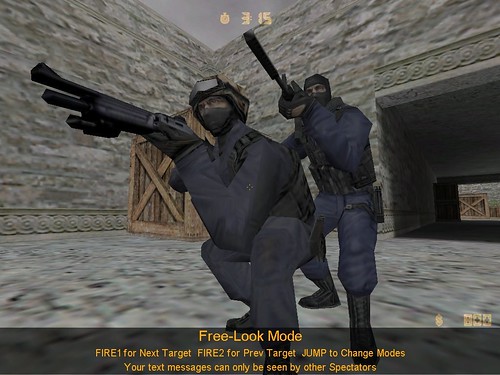
His son, Griffin, became addicted to CounterStrike. This is the story of the conflict within the family.

But because Dad, at one stage, decided to feed the addiction it is also a story about a CounterStrike tournament, his son's the Clan - Down Town Games, interviews with unconvincing games industry spokesperson (Doug Lowenestein), equally unconvincing moral crusaders and various reflections about Rating Systems, a 2000 yo debate, the generation gap and more.

Tracking down his son in the middle of the night to a games parlour, " ... an electronic hook soothed by the balm of bloodless killing ... I'm near him now, he doesn't even know I'm here" .. cut to beautiful and tragic music from an opera

"War is a game ... happiness is a digital bomb"

This debate is 2000 years old. Aristotle and Plato debated whether to ban Homer.
Aristotle: violence purges the emotions, produced catharsis.
Plato: Violent images provoke violent behaviour.

Lt. Col David Grossman, who blames computer games for one of those horrible school yard massacres, that occurred in his hometown. He tours America giving lectures about this.
Rhetorical question: "Why are video games violent"
Answer: "Because violence is the addictive substance".

However, it turns out that Grossman could not name the video game that the young killer was playing. Benger then went to the trouble of finding a psychiatrist who had interviewed the killer who contradicted Grossman's interpretation.

The inventor of CounterStrike, 23 yo Minh Lee, fled the Vietnam war zone in a boat when 2 yo to end up in America making a game about violence and mayhem. He has a picture of a baby harp seal on his wall. Nice twist. In response to a question he says: "If people can't control themselves, then it's really not my responsibility"

Interviews with various parents who's sons are "hooked":

Interview one:
I turned off his computer. He grabbed my arm. Gave me a look as though he wished me dead. Threw the coffee table across the room. (nearly in tears)

Interview two:
Woman with 2 dogs on the couch. One of their sons had a seizure when playing a war game.

Interview three (Benger's wife):
Whenever Griffin was faced with anything difficult he would turn to the video game as an escape from the difficulty.

Interview four:
Video games are keeping him away from truly dangerous stuff like drugs and alcohol.

Back to Bengers' voice over:

"... the nagging overscheduled world of the urban child"

"my youth has no relevance to his ..."

"I lost the battle to keep the dark side of the information age out of my home"

"Not one of us knows what effect these games are having on the minds that shape the 21st Century"

Some melodrama here, yes, but gripping viewing too. I highly recommend this video and use it in my games course.

space and time on the web

Thanks to Roland, I was asked recently by Andrew Tierney to write a piece for Infonet, the VITTA Journal (Victoria). I've sent him the following which is a review of Chapers 2 and 3 of David Weinberger's Small Pieces Loosely Joined. If there are any cartoonists or artists reading this then I'd love to be able to talk to you about a drawing a graphic which represents the space and time of the net, eg. see the paragraph about "... rooms with magic doors"

WorldWideWebAroundWikipedia

The Web changes our perception of Space and hence changes our perception of what it means to a human living in space.

Real world space has the hard edges of fixed dimensions. It is a pre-existing container of fixed size that we are stuck with as part of reality. Geography can be and often is a restrictive tyranny. Australia has been described by historians (Blainey) as the tyranny of distance.

Web space, by contrast is entirely created by humans. It's not a fixed space, it's an expanding space, Google is searching 8,058,044,651 web pages and returns results in a fraction of a second. That is almost miraculous :-)

Now we have blogs and sites that search and categorise blogs. Check out technorati, bloglines etc. It grows. And as it gets bigger your ability to find your way around has perhaps surprisingly increased. Search has dramatically improved. It's now far easier to find and conveniently reference quality information on the Web.

Imagine a place with billions of rooms with magic doors that are psychically linked to other rooms by the interests of the people travelling from room to room. Your nearness to other rooms is created by your level of interest. Is that magic or is that the Web?

When you visit a web site do you feel that the web site is travelling to you or that you are travelling through space to the web site? Even though the web page is being downloaded to my computer my subjective feeling is that I'm travelling somewhere else to that web page. The Web has the feel of place about it, it is place-ial, so it feels spatial
In the final analysis, we seem to have a choice of metaphors that are equally suited to the task. We could think of the Web as a giant photocopier that delivers copies of sites. We could think of it as a medium through which we see sites. We could think of it as a library from which we request copies. But we don't. We experience the Web as a web: a set of nodes that are linked one to another, creating a space through which we travel. (40)

Real world time is an irreversible, relentless river, once it has passed we cannot retrieve it.

This is old knowledge, the Greek philosopher Heraclitus said, "You can't step into the same river twice"

In the real world not only is there a tyranny of distance there is also a tyranny of the NOW. We always operate in the present and if we stuff badly then there is sometimes no going back.

Weinberger uses the metaphor of a beaded necklace passing over a blade, remorselessly, one bead at a time.

But time on the web is more like a hand writing than a necklace being pulled across a blade. On the Web there are many branching threads of conversation which extend backwards and forwards in time. The threads are often unfinished, the conversation can continue at any time convenient to the participants.

In the real world time and space are divided into uniform units. On the Web the feel of time and space is much more elastic.
It is not an accident that the Web is distracting. It is the Web's hyperlinked nature to pull our attention here and there. But it is not at all clear that our new distractedness represents a weakening of our culture's intellectual powers, a lack of focus, a diversion from the important work that needs to be done, a disruption of our very important schedule. Distraction may instead represent our interests finally finding the type of time that suits us best…. Our experience of time on the Web, its ungluing and regluing of threads, may be less an artefact of the Web than the Web's enabling our interest to find its own rhythm. Perhaps the Web isn't shortening our attention span. Perhaps the world is just getting more interesting. (69)

Tags:

Sunday, April 02, 2006

quadratics instruction

I received this letter recently about an article and program I wrote in logo 10 years ago for teaching quadratics. The program still runs on a modern XP Windows although the interface looks very old fashioned today. One possibility would be to rewrite it for an open source version of logo such as George Mills and Brian Harvey's MSWlogo.
I was reading your paper on quadratics software that you wrote, I am a masters student and I am doing my research on Computer Aided Instruction in quadratics. I would love to look at your software and maybe use it with my students that I am teaching. Are you willing to share your software? I of course would share my research results with you upon completion.
I teach high school math (10th and 11th ) grade and I have a group of students that have not received quadratic instruction and are in need of a program to learn from. My school is South Kitsap High School the largest high school in the state of Washington in the US. We have 2600 students in three grades. We recently changed math programs and now there is a group of students that have not been educated on quadratics and I need to find a fast and effective means to fill that gap. Your program may be just the ticket.
I look forward to hearing from you.


encouraging letter

I received this encouraging and interesting letter from Canada last week. The reflection about programming is interesting from the perspective of learning styles:
I am a young man of 23 years of age, and have just finished reading your article entitled "Something is making me do it" which I feel compelled to write to you about.

I first want to say how great I think it is of you to teach kids/teens about game making and basic programming skills. You definitely have the right attitude and are on to something.

I myself am struggling with Game Maker, trying to learn how to make it do my deeds, with the larger goal of building interactive games of fine craftmanship. I do not consider myself a programmer, I really despise computer programming, but my creative urges are pushing me to overcome this feeling. I consider myself more of a artist/designer.

So, for me, it really is a matter of:

Creative work (right side of the brain) v.s. Logical work (left side of the brain)

The exciting stuff is in thinking up the design, the game rules, the look, the gameplay.

The boring head-splitting part is actually implementing it. In particular, the logistics, the scripting.

I get sick of it quite easily, I'm still at a fairly early stage of development, and am trying to deal with it by tiny incrementals.

Friendly, image-rich tutorials help a lot, since I'm a visual kind of guy, and I try to introduce myself to the logical part slowly, piece by piece. I also try to psychologically separate creative tasks from logical tasks. So, when I'm coding, I leave all the excitement from the creation alone, and try to concentrate on the mathematical aspects. Separating the two helps a lot.

That's all I wanted to say

game making year 11 mid semester report

I have designed a one semester game making / multimedia course for Year 11 students. This is a report of progress so far this year. The full course can be found at http://users.tpg.com.au/billkerr/g/y11.htm

COURSE INGREDIENTS (partial)

  1. game making – for motivation, engagement initially but also for worthwhile objects to think with
  2. blogging – for opening up new channels of communication in the classroom
  3. explicit instruction about programming, just in time approach
The blogroll of all students in the class can be found here on the teachers blog: http://gamedesign11.wordpress.com/ If you visit student blogs then please consider leaving an encouraging or thoughtful comment there for them. I have parents permission to publish the blog URLs.

The initial setting up of blogs did take some time but in the longer term it was time well spent.

Some students adapted quickly to both game making and blogging, others took several weeks to become productive and a few did not engage sufficiently in one or the other parts of the course.

The teachers marking scheme gave 5 marks for each game maker challenge. Students had to complete the challenge (they could ask anyone for help), blog about how they solved the problem (3 marks), about who helped them (1 mark) and include a screen shot of their solution (1 mark). The teacher kept an up to date open marks book which students could look at to monitor their progress at any time. Assigning percentages and grades two weeks before assessment period was a powerful motivator for some students who were behind to catchup.

Students could also get marks for off topic blogging (limited to one mark per week), writing how to tips about game maker, game maker problems and setting up their blog expertly (theme, blogroll, leaving comments on other blogs).

Writing about how a problem was solved does help to reinforce the learning process.

Quite a few students did read the blogs of more advanced students, who had detailed descriptions, for tips about how to solve problems. Pikmik and JRB01 were two favourites for this. (plan to do a survey about this)

The teacher setup an RSS feed at bloglines which collected all student blogs in one place and informed him when their blog had been updated. This was very convenient and make it possible for the teacher to give more regular feedback than in previous years. It was also possible for the teacher to obtain a more rounded picture of student interests through their off topic posts. This built rapport and lifted morale.

Some students obviously enjoyed leaving comments on each others blogs, this was seen as a fun activity.

COURSE RATIONALE

Why choose Game Maker as the programming language?

Game Maker has a free version (but not open source), has a great drag and drop interface, low entry and high ceiling programming capabilities, extensive support materials and a large, active community (Game Maker forum). Since the software is free it was included on a CD with other free and open source software which was made available for students to take home.

Game making challenges – the focus on challenges rather than demonstrations or tutorials

The initial part of the course consists of skill building in the use of Game Maker through solving a series of challenges that are accompanied by hints. By solving the challenges students learn some of the basic skills of game programming such as:
  • what Events mean (Create, Step, Alarm, Collision, etc.)
  • how to link Events to Actions
  • the coordinate system (x, y space) and direction
  • how to use the random() function to vary motion
  • how to make characters shoot and targets explode
  • how to turn actions of temporarily using Boolean T/F variables and Alarm clocks
  • how to make one character follow another character
  • how to control game flow using conditionals
  • how to draw text on the screen
  • how to push things around a room

All of the challenges are available at this URL: http://users.tpg.com.au/billkerr/g/ch.htm

In general, I think challenges are more effective than either Demonstrations or Tutorials for teaching and learning. Why? Challenges involve both construction and struggle!

Challenges – student has to struggle for mastery, the teacher is a guide on the side providing hints or direct guidance occasionally.
Demonstrations – teacher shows how to do it, student is relatively passive at first, construction is optional.
Tutorials – Step by step instruction provided by teacher, student follows. This can be too passive, not enough exploration or struggle is required.

http://billkerr.blogspot.com/2005/07/tutorials-demos-challenges.html

I think you need the full range of tutorials, demonstrations (which are more show and tell) as well as the challenges / hints (explore, think, do, ask questions) but overall I'm trying to push my students towards the latter mode.

Why blogging?

As well as the curiosity and appeal of a new technology I was motivated by other reasons to incorporate blogging into the course.

Writing and documentation is an important part of programming (including comments within code) and improves the employability of a programmer. The method of writing every day is a good one because writing improves with regular practice.

The teacher ability to communicate with students is quite limited in a face to face setting with a class size of 20. Opening up another regular written communication channel vastly improves teacher-student communication. This can be used extensively for feedback and also enables students to share off topic thoughts with the teacher.

Once students have setup blogrolls of other students on their blogs then student-student communication increases as well. This can be used for both fun and learning.

Saturday, March 25, 2006

questioning research

perplexed
I'm reading some research papers in preparation for a presentation I'm due to give at ACEC in Cairns later this year. This paper was recommended by Tony Forster.

Questioning the Questions of Instructional Technology Research

The author, Thomas Reeves, starts from the premise that when research is done using taxpayers money that the research students should be counselled / pressured into chosing topics that are more socially important than what motivates people to take SCUBA diving courses.

There are important social issues in the world - adult illiteracy, attacks on public education, "at-risk" students, homelessness, AIDS etc.

He goes onto argue that the goal of educational research must be to improve education not just to understand what is happening. Institutionalised Education is not a natural phenomenon, it is "man-made" so there is a need to make it better.

This is an old but still important argument, the distinction between knowing the world and changing the world. Marx critiqued Feurbach along those lines too:
The philosophers have only interpreted the world, in various ways; the point is to change it.
I agree with Thomas Reeves on this basic premise and he follows this thread through in a practical sort of way.

He's tough on the issue of pseudo-science. He says that a lot of research is not up to scratch based on criteria. Figure 6 is the key link. The critique he is making of most educational research is along these lines:
  • lack of linkage to a robust theory
  • inadequate literature review
  • hard to measure variables are not measured reliably
  • outcomes of research have little or no relevance for the subjects in the study
  • statistical analysis is fudged
  • rambling, often incoherent discussion of results
He frankly states that there is an "incestuous relationship" between many researchers and peer reviewers.

This critique is frightening for our Game Making cluster IMO because most of us are not trained in such a rigorous research approach and are too busy, don't have the time / resources to read all the relevant literature, study up on statistics etc. We are practitioners who have dabbled in educational theory without reaching the rigorous standards demanded by Thomas Reeves.

However, his solution to this problem in a way lets us off the hook and steers around the above critique by suggesting a different sort of approach to educational research. He wants academics to work more closely with schools to strive to make a difference there, "where the real needs are so great." That the goal of educational research must be to make a difference, "in schools with real problems".

This is something members of our Game Maker cluster can relate to because that is what we are on about, that is our core business, and what brought us together in the first place. However, I don't really believe that we are off the hook entirely. What is our core theory? What literature have we read? Have we thought about those hard to measure variables? Statistics? We need to do some of this.

Reeves concludes with a summary of a couple of instances of developmental research that he does like.

One is Idit Harel's (1991) Instructional Software Design Project, which I have read and was so impressed by that I tried to emulate it a few years ago (yet to publish my paper on that).

The other is a study by Richard Lehrer(1993) where eighth graders used HyperAuthor to design their own lessons about the American Civil War. ... based on Perkins theory that "knowledge is a process of design and not something to be transmitted from teacher to students..." One interesting result of this study is that important differences were found a year later (but not immediately). The control group forget whereas the constructionist group remembered history as "a process of interpreting the past from different perspectives ..."

I agree with Reeves idea that theory is important and have been gradually reviewing my already established ideas about constructionism and thinking more about George Siemens new idea of connectivism. How do those theories relate to what I am doing with Game Making and blogging?

Reeves paper also influenced me in thinking about going beyond an empirical, quantitative approach and to make the effort to integrate the above theories with what I observe my students doing when they solve game problems and blog about that.

Tags:

Sunday, March 19, 2006

learning maths

Steve Yegge offers some advice about learning maths. He takes a programmers perspective but his article ranges beyond that perhaps. I might accept his advice and learn some more maths. Here are some extracts that I found particularly useful. The place to start would be his paragraph about using wikipedia. That is a really interesting idea and tremendous praise for wikipedia. I've taken the trouble to put in some links to wikipedia in my extract below.

The Math They Didn't Teach You

... most of the math you learn in grade school and high school is continuous: that is, math on the real numbers. For computer scientists, 95% or more of the interesting math is discrete: i.e., math on the integers...

For programmers, the most useful branch of discrete math is probability theory... How many ways are there to make a Full House in poker? Or a Royal Flush? Whenever you think of a question that starts with "how many ways..." or "what are the odds...", it's a probability question.

Other important maths topics for programmers ... Statistics, Algebra and Linear Algebra (i.e., matrices), Mathematical Logic

Information Theory and Kolmogorov Complexity ... Information theory is (veeery roughly) about data compression, and Kolmogorov Complexity is (also roughly) about algorithmic complexity. I.e., how small you can you make it, how long will it take, how elegant can the program or data structure be, things like that.

complex-graphic480x480


The Right Way To Learn Math

The right way to learn math is breadth-first, not depth-first ...

The right way to learn math is to ignore the actual algorithms and proofs, for the most part, and to start by learning a little bit about all the techniques: their names, what they're useful for, approximately how they're computed, how long they've been around, (sometimes) who invented them, what their limitations are, and what they're related to. Think of it as a Liberal Arts degree in mathematics.

Why? Because the first step to applying mathematics is problem identification ...

I think the best way to start learning math is to spend 15 to 30 minutes a day surfing in Wikipedia. It's filled with articles about thousands of little branches of mathematics. You start with pretty much any article that seems interesting (e.g. String theory, say, or the Fourier transform, or Tensors, anything that strikes your fancy. Start reading. If there's something you don't understand, click the link and read about it. Do this recursively until you get bored or tired.

Doing this will give you amazing perspective on mathematics, after a few months. You'll start seeing patterns — for instance, it seems that just about every branch of mathematics that involves a single variable has a more complicated multivariate version, and the multivariate version is almost always represented by matrices of linear equations. At least for applied math. So Linear Algebra will gradually bump its way up your list, until you feel compelled to learn how it actually works, and you'll download a PDF or buy a book, and you'll figure out enough to make you happy for a while.

With the Wikipedia approach, you'll also quickly find your way to the Foundations of Mathematics, the Rome to which all math roads lead. Math is almost always about formalizing our "common sense" about some domain, so that we can deduce and/or prove new things about that domain. Metamathematics is the fascinating study of what the limits are on math itself: the intrinsic capabilities of our formal models, proofs, axiomatic systems, and representations of rules, information, and computation.

Saturday, March 18, 2006

globalisation

flat_200
In The World is Flat, Friedman claims that the flattening of the world - globalisation - is the single most important trend in the world today.

In answer to the charge that he is a technological determinist he pleads "Guilty as charged". If we create the internet, work flow software, cell phones then people will use them in all sorts of ways including many not intended by their creators. New technology changes the world forever and often in unpredicted ways.

So, as implied, he then goes onto say that he is not a historical determinist. We can use the internet to develop open souce software or to make plans to end poverty in Africa, or, alternatively to plant a weapon of mass destruction in New York City. The future is up for grabs.
I am certain, though, that the world has been shrinking and flattening for some time now, and that process has quickened dramatically in recent years. Half the world today is directly or indirectly participating in the flattening process or feeling its effects. I have engaged in literary license in titling this book The World is Flat to draw attention to this flattening and its quickening pace because I think it is the single most important trend in the world today.

But I am equally certain that it is not historically inevitable that the rest of the world will become flat or that the already flat parts of the world won't get unflattened by war, economic disruption, or politics. There are hundreds of millions of people on this planet who have been left behind by the flattening process or feel overwhelmed by it, and some of them have enough access to the flattening tools to use them against the system, not on its behalf... (375)
At the moment US Imperialism, somewhat crazy, and the jihadists, totally crazy have stepped onto the stage of history and are fighting it out. China is the sleeping giant, but not so sleepy.

I've read Friedman's book and am prepared to recommend it as essential reading to understand the world today. Friedman advocates a multifaceted plan to save America from its entitlement mentality that he thinks will destroy the country over the next 15 years unless something is done. I don't advocate his book for that reason but because along the way he presents a deeply insightful analysis of the most important trends happening in the world right now.

He gives us a big slab of the big picture.

100 dollar laptop

tn-laptop-crank
Philanthropy is the human face of capitalism, which does not transcend the exploitative nature of capitalism. Bill Gates is the world's biggest philanthropist. He rips us off and then gives to the poor. Does that make him a nice guy? No.

People like Nicholas Negroponte (former head of the MIT Media Lab) spend a lifetime building a career in innovative IT. Having achieved personal success and some fame they then want to do something for the wretched of the earth.

The One Laptop per Child project is technically brilliant, highly ethical and well intentioned. But won't it be undermined by the very forces that made Nicholas Negroponte a success in the first place?

There has been quite a lot of detail provided about the technical and entrepreneurial aspects of this project but very little about how it will work in the nitty gritty sense of what will actually happen on the ground when the computers are introduced. The main issue has yet to be addressed fully.

Alan Kay did mention the problems of the grey market and some of the social issues in this talk:
One big problem is the grey market. They’ll be diverted from children unless you do something to protect the laptop. A few ideas: an RFID card keyed to the specific owner helps. The device is networked, so the owner of the device has to log in every few days to get a token to keep it working. The color (green) helps. The child’s picture could be embedded in the plastic case....

From an educational standpoint, this project could be a colossal flop if the content isn’t right. What’s the right interface for children in an environment where the adults can’t help much. Can you connect children to pen-pal like mentors over the Internet? The logistics are monumentally hard.

James Robertson in a commentary on Alan Kay's talk pointed out:
I like that he's recognized the problem of the grey market - but I think his proposed solutions will drive up cost without actually accomplishing much. If you are trying to introduce an item of value into an area that, in general, cannot afford the extant commercial products, then a lot of your target audience will try to sell the item. It's really that simple.

Having said all that, I like this summation:
The important question surrounding the $100 laptop is “will it be more than a mere technological artifact?” The answer depends on whether the content, and especially the mentoring, can be brought along with it to have real impact.
If they pick their target markets correctly, and are able to provide the right content, it could work. On the other hand, if that market exists, I expect that one or more commercial vendors will end up serving it.


Bill Gates is criticising inaccurately (it's not a shared use computer) from the sidelines gearing up to move into the market that will be produced by the MIT philanthropists
"The last thing you want to do for a shared use computer is have it be something without a disk ... and with a tiny little screen," Gates said at the Microsoft Government Leaders Forum in suburban Washington.

"Hardware is a small part of the cost" of providing computing capabilities, he said, adding that the big costs come from network connectivity, applications and support.

Before his critique, Gates showed off a new "ultra-mobile computer" which runs Microsoft Windows on a seven-inch (17.78-centimeter) touch screen.

Those machines are expected to sell for between $599 and $999, Microsoft said at the product launch last week.


Reality check: The philanthropist Negroponte is paving the way for the bigger philanthropist Gates to make some more money.

HERE IS SOME BACKGROUND INFORMATION FROM THE PROJECT SITE:
Nicholas Negroponte, chairman of One Laptop per Child, answers questions on the initiative
What is the $100 Laptop, really?
The proposed $100 machine will be a Linux-based, with a dual-mode display—both a full-color, transmissive DVD mode, and a second display option that is black and white reflective and sunlight-readable at 3× the resolution. The laptop will have a 500MHz processor and 128MB of DRAM, with 500MB of Flash memory; it will not have a hard disk, but it will have four USB ports. The laptops will have wireless broadband that, among other things, allows them to work as a mesh network; each laptop will be able to talk to its nearest neighbors, creating an ad hoc, local area network. The laptops will use innovative power (including wind-up) and will be able to do most everything except store huge amounts of data.

How will these be marketed?
The laptops will be sold to governments and issued to children by schools on a basis of one laptop per child. Initial discussions have been held with China, India, Brazil, Argentina, Egypt, Nigeria, and Thailand. An additional, modest allocation of machines will be used to seed developer communities in a number of other countries. A commercial version of the machine will be explored in parallel.

When do you anticipate these laptops reaching the market? What do you see as the biggest hurdles?
Our preliminary schedule is to have units ready for shipment by the end of 2006 or early 2007. Manufacturing will begin when 5 to 10 million machines have been ordered and paid for in advance.

The biggest hurdle will be manufacturing 100 million of anything. This is not just a supply-chain problem, but also a design problem. The scale is daunting, but I find myself amazed at what some companies are proposing to us. It feels as though at least half the problems are being solved by mere resolve. http://laptop.org/faq.html


Friday, March 17, 2006

does it matter if we redefine literacy?

I have read books full of dense text and containing no graphics whatsoever which argue cogently for the recognition of new literacies. Gee on Video Games and Literacy does this. Rheingold on Virtual Reality did this.

Video games, Virtual Reality. No pics. Must have been a serious and important analysis.

Why? Is it because words are the most powerful way for them to convey their message of the importance of other media? What a tremendous irony that would be! Or is it more to do with the economics of marketing a new book, that their publisher would not take the risk of the extra expense? Money. Or is it because they are older generation interpreting the world of the younger generation to other members of the older generation? No pics required for that?!

I have a deep feeling that ability to read and write text is so important that anything that diminishes its importance ("waters is down") is so dangerous that we shouldn't do it. I also have another deep feeling that everything changes and that the changes are speeding up - so what does it really matter if we modify the meaning of the word, "literacy"?

I can't make up my mind.

So my question is: Does it matter if we redefine literacy?

At the national game maker forum Ken Price wrote this:
your article on Prensky's talks is useful. I was intrigued when I saw the use of the term "literacy" and multiple categories, as I have been watching the term morphing from its original meaning ("literate" meaning "one who knows the letters" i.e. one who can read write and make meaning of text) to a new meaning which in broad term means fluent, competent, able to interpret. Literacy seems to have become the bray of any group that believes it is important (I have recently seen financial literacy, productivity literacy, business literacy and drug literacy, and am eagerly awaiting golf literacy to make my life complete...)

I was thus happy to see your literacy referred to actual literacy within various areas of activity!

The literacies which I referred to in my article were as follows:
Literacy of traditional school: 3 R's plus sit still, listen to the teacher, take notes (broadcast)

Literacy of game play: Play games, solve problems, level up (have fun while you learn what?)

Literacy of computer programming: use logic, functions, conditionals, debugging etc. to solve particular types of problems (higher order thinking?)

Literacy of the two way web: search, blogs, wikis, podcasts, IM etc. (learn to use the universal pipe)

In response to Ken at the national gamemaker forum I wrote this:
as all media becomes digitial then there's bound to be a morphing b/w text and other digital forms IMO - eg. the intro to Baz Luhrmann's romeo and juliet was when I first noticed, a text had been turned into a multi media experience to make it more accessible -- digitising text changes it nature(?)

I suppose that's mixed in with the use of the word 'literacy' to try to claim the high moral ground

thanks for reminding me of the original meaning, yes I had forgotten

I'm still thinking about it and interested in other opinions.
RomJulie

Thursday, March 16, 2006

what is technology?


I've been rereading about Alan Turing, one of the inventors of the idea of the computer, and Douglas Hofstadter's Godel, Escher, Bach. It's slow going because sadly, I've neglected my maths over the years.

This relates to the old discussion / biases about technology. Some people see technology as reactionary, eg. The Greens, Braverman, Theodore Roszak, Michael Apple. Others see it as neutral, just a tool that can be used for good or bad. I see technology as having a life and evolution of its own, its own internal dynamic. We are co-evolving with technology.

To ask, "Is technology progressive?" is equivalent to asking, "Are humans progressive?" My answer is "yes" but it's the wrong question to start with.

I think we can say that humans are technology. I've long been aware of an essay by Engels (1876), The Part Played by Labour in the Transition from Ape to Man, which argues that the hand preceded and in turn assisted the evolution of the human brain.

Alan Turing's concept of the universal computer is saying the same thing from another direction. Humans are technology.
" ... there is really only one kind of computer, or, more precisely, that all kinds of computers are alike in what they can and cannot do .... whether its' built of transistors, sticks and strings, or neurons ... making a computer think like a brain is just a matter of programming it correctly."
- W. Daniel Hillis, The Pattern on the Stone, p. ix
My point is that you have to ask the more fundamental, structural question, "What is technology?" first in order to answer the sociologists question, "Is technology progressive?" The latter question is the wrong question because it immediately encourages people to separate humans from technology whereas in reality we are just two different variants of an evolutionary process.

Part of this thought was triggered by a recent essay by Jeremy Price, Technology as Trickster, where he rejects both the ideas of technology as neutral and the McLuhan idea of "techno-zen environment/ecology" (technology as just a medium). Jeremy draw his metaphor by imaginatively cross fertilising from a book by Lewis Hyde, Trickster Makes This World, linking Hyde's observations about human behaviour to machine behaviour. Jeremy's conclusion:
The idea of technology as neutral, as a hammer or screwdriver to do with as we please, sits uncomfortably with me. The strict Canadian-McLuhan ideal of a techno-zen environment/ecology ("technology exists") similarly does not work for me, for while I like the idea in theory, I cannot get away from my American bias towards the idea of "progress." In my mind, the idea of Technology as Trickster allows for progress but not in a way that is our own design; try as we might to deny it, technology still has agency. Technology may not have a "human consciousness" (I think we're still working on a definition of that one), but it is something to be engaged with -- not to be controlled. Technology may not be aware of the upheaval it engenders, but we can be, and part of our engagement with technology is an acceptance of change and a vision for making the best of complexity in order to improve ourselves and others.

Wednesday, March 15, 2006

prensky ripples

Interesting discussion about the significance of Prensky by Seb, Pete and Mike from the PowerHouse Museum . I think they have all made valid points, here is rough attempt at summary:

seb: a lot of what is developed (games, whatever) has modern capitalism / consumerism / market as an underlying driving force and ought to be critiqued from that perspective

pete: engagement is essential starting point, worthwhile learning is fun, push is in decline - we need shared learning, mutual respect, "consumer" co-creation

mike: "universal truths" are suspect, why should reading (Emma) be priviledged over film (Clueless) - digitial immigrants may emotionally privilege reading over everything else but there is no logical justification for this

my comments:
As well as reading books we ask students to write
As well as watching film we ask students to make film
As well as playing games we ought to ask students to learn programming and make games
(prensky seemed to be not clear about this)

Digital immigrants (like me) will continue to be fuzzy about the real significance of games -and not be able to do critical analysis - because not being a very skilled game player means that it's not up close - just like any other immigrant

With regard to the changing meaning of literacy I'd recommend a book by James Gee: What video games have to teach us about learning and literacy

Here are some of my blog entries that relate to this discussion:
http://billkerr.blogspot.com/2006/03/literacy-wars.html
http://billkerr.blogspot.com/2006/03/value-of-game-playing.html
http://billkerr.blogspot.com/2005/04/beyond-print-literacy.html
http://billkerr.blogspot.com/2005/07/problem-of-content.html

Tuesday, March 07, 2006

the value of game playing?

Ken Price (Tasmanian Education Department) has just published the following on an Australian game making forum. I think it's great so I asked him for permission to reprint and he agreed. I'd see it as part of the ongoing debate sparked by Marc Prensky's visit.
Disclaimer:
this might look a bit like a "games are pointless" crusade. Nothing is further from the truth: I have high regard for any skilled intellectual or physical human activity and my bookshelf attests to my interest in play and fun in education, including my partner's thesis on the Philosophy of Play and mine on Humour in Learning. However, I am noticing a trend amongst the educational evangelists that is based on rather shallow logic of "kids like online games, which justifies their use in education" rather than a more meaningful look at what it is about game playing that we can use effectively and in a planned fashion.

Begins:
A few years ago, one of Those Parents (you know the sort) started a conversation at a parent evening. His claim was that schools ought to teach kids golf. In fact, they should teach golf for at least an hour a week, he claimed, or we were doing our kids a dis-service. Why? Well, unless we taught them golf, they would never be as good at golf as if we had taught them. So teach them we must.

Nice circular argument. You can replace "golf" with just about anything you like in that paragraph: juggling, rabbit-skinning, stamp collecting, Czech, calligraphy or fire-breathing.

Where it falls apart is that the "golf" or whatever is somehow assumed to either have undisputed personal or social value (as may be the case with reading) or transferability (as may be the case with say the development of confidence in speaking to a group). As it happens, my friends tell me that the physical skills of golf do not transfer well to other sports: high-end players in other sports often do well at golf, but not vice versa. And the social/business function of golf is not the stuff that we'd focus on in schools if we taught golf.

So the question arises: does computer-based game playing have some inherent vaue of its own, and/or are there skills or knowledge involved that transfer to the real world (the non-game world)? In particular, are there skills that are demonstrably useful in wider education? The article at the head of this page suggests a number of well-documented problems associated with gaming: what are the corresponding benefits?

The argument that games represent an important part of modern culture holds some water. However, as kids deal with this quite well without assistance it is difficult to see how digital immigrants like (many) teachers are needed in the process.

The engagement/motivation argument is also a bit questionable on its own: some kids are engaged with fashion, car theft, TV shows or horse riding , but these are not in themselves a basis for pedagogical decisions. We might make use of their interest to guide them, but not take it to extremes.

It may be argued that the game world is no less real than say the world of stock market trading, where people buy and sell tonnes of zinc or pork bellies or orange juice concentrate or apartments without physically handling them. However (perhaps questionably) the latter are seen as contributing to economic and social growth, and of benefit to society. This characteristic does not (in general) hold for computer-based games (though there are significant examples where it does).

I had on my office wall an old cartoon by Gary Larson called Hopeful Parents. It shows the usual vacant Larson parents proudly watching their kid play a computer game, while a thought bubble above their heards showss a newspaper open to job adverts like "Nintendo expert wanted $50,000 salary...Wanted SuperMario Player, $100,000 plus your own car ... Can you save the Princess? We are hiring skilled staff NOW" etc. The satire still works.

None of this in any way detracts from the value of students DESIGNING and BUILDING games. The planning, team work, research and intellectual work involved is significant and (I would argue) very similar to that needed in a range of future employment and social settings. I would prefer however to have a better research base for the value of online games, so that kids are building entities with a value that is easier to justify and demonstrate.

Monday, March 06, 2006

literacy wars

I went to two different Prensky presentations, one was to students who had made games and the other was to adults (95% over 25 yo). I've written a summary here.

Prensky used the same slides in both presentations but his emphasis was very different in each.

For the students he focused mainly on games. He would ask for a favourite game and then talk about it. He knows his games. Or he would suggest the name of a game and pick up on the response he got. He would start with games and link it back to some aspect of learning.

For the adults he focused mainly on engagement. He said the problem is not ADD but EOE. Translation: Engage me or Enrage Me. Schools are failing at the level of engagement.

For the adult talk, he spent just as much time talking about the two way web: blogs, wikipedia, podcasting, IM / chat, etc. Games were in there as well, but he went to pains to say that the guiding principle was engagement, not games. I wondered if the audience would have been so large (the place was packed at $220 a head) if Prensky's talk had been marketed along the line of "engagement and learning" rather than "games and learning". I think not. There is a lot of curiosity around at the moment about games and what they mean. This was one focus of my talk last September at the Game Programming in Schools Conference.

Of course in doing this Prensky is adapting his talk to the audience. Young people often know games well, adults often do not. For Prensky the key learning factor is engagement and he practices what he preaches.

At one point he said, "Young people play the game while the adults read the manual".

He seemed to be saying that the former was better and the latter old fashioned.

Although there is some truth in this (the ability of young people to learn a lot of new things with a hands on approach) it is also possibly a dangerous oversimplification. As a teacher of the young I know for sure that I'm often a step or two ahead of them because I am prepared to read the manual or the online Help, etc. It's a complicated and not a simple distinction. I've also learnt that for programmers presentation, documentation and commenting of code is extremely important.
"Programs must be written for people to read, and only incidentally for machines to execute"
- H. Abelson and G. Sussman (in "The Structure and Interpretation of Computer Programs)
Then when Kerry Smith asked Prensky a question about the role of game making in schools for some reason he didn't step up and assert this as part of his position. That game making is something we should be doing in schools today. This surprised me because I know he is involved in making games himself. For example, he has a project going called Algebrots which is promoted along the lines of "beat the game .... and pass the course". It could be that Prensky just missed that opportunity, there was a panel session in progress. But then I thought, maybe game making isn't in his current mindset for this audience.

Prensky even advanced the idea that adults / teachers could use the new technologies without learning them thoroughly!! This didn't sound correct to me. There is always a proportion of less advanced students in your class who do need clear, concise step by step instructions. Or at least that seems to be true for classes that I teach.

Different presentations for youth (games) and adults (engagement). 'Play the game' versus 'Read the manual'. Game playing or game making?

Whilst mulling over this it occurred to me that what is really going on in all of this complicated dialogue is an example of literacy wars and that the literacy wars are hotting up.

Literacy of traditional school: 3 R's plus sit still, listen to the teacher, take notes (broadcast)

Literacy of game play: Play games, solve problems, level up (have fun while you learn what?)

Literacy of computer programming: use logic, functions, conditionals, debugging etc. to solve particular types of problems (higher order thinking?)

Literacy of the two way web: search, blogs, wikis, podcasts, IM etc. (learn to use the universal pipe)

I'm putting this forward as a different way to think about some of the issues that Prensky is raising. One way to approach it is from the point of view that the concept of literacy keeps changing, it's a moving target, and that when we disagree and argue it might be because we value one literacy over another. And not because that literacy is necessarily "better" but because we grew up with it and are more comfortable with it. All of the above literacies have some value depending on the context. I think our job as teachers is to combine them in creative ways that do engage and not enrage our students.

Personally, what I'm currently trying to do in one of my Information Technology classes is to combine the literacy of game programming with the literacy of blogging (students writing in a new, more connected medium) . I think requiring students to write more about their game programming will be good for both their programming and writing skills. I'm not sure whether what I'm doing connects closely with Prensky's message or not.

Sunday, March 05, 2006

On Lisp by Paul Graham

This is the best argument in favour of bottom up design I have ever seen. Download his book here.

Some quotes:
Lisp is a programmable programming language

As well as writing their programs down towards the language, experienced Lisp programmers build the language up towards their programs

Bottom up design is becoming more important as software grows in complexity

The title is intended to stress the importance of bottom up programming in Lisp. Instead of just writing your program in Lisp, you can write your own language on Lisp, and write your program on that.

... the association between Lisp and AI is just an accident of history ... Recent advances in hardware and software have made Lisp commercially viable: it is now used by Gnu EMacs ...

Lisp itself is a Lisp program and Lisp programs can be expressed as lists which are Lisp data structures

The plan-and-implement method is not a good way of writing programs

In Lisp, you can do much of your planning as you write the program ... nothing clarifies your ideas like trying to write them down

... the final design is always a product of evolution

Language and program evolve together ...

Like the border between two warring states, the booundary between language and program is drawn and redrawn, until it eventually comes to rest along the mountains and rivers, the natural frontiers of your problem ... your program will look as though the language had been designed for it ...

Instead of a lintel, you'll get an arch ...

Advantages of bottom up design:
  1. ... programs which are smaller and more agile
  2. ... promotes code re-use
  3. ... easier to read
  4. ... it causes you always to be on the lookout for patterns
No other language has anything like Lisp macros

... programs are data ...

... you can build a whole language on top of Lisp, and write your programs in that ...

Like an arch, Lisp is a collection of interlocking features ... dynamic storage allocation and garbage collection, runtime typing, functions as objects, a built in parser which generates lists, a compiler which accepts programs expressed as lists, an interactive environment ... It is the combination

Fortran was invented as a step up from assembly language. Lisp was invented as a language for expressing algorithms

Efficiency! (Fortran) versus Abstraction! (Lisp)

... the outcome of this battle is being determined by hardware. Every year things look better for Lisp ...


Saturday, March 04, 2006

papert's Mindstorms

I've republished a review I wrote in 1990 of Seymour Papert's ideas based on a thorough reading of his most important book, Mindstorms and some other texts.

In 1990 Papert's theory of constructionism (Papert's word, a combination of Piaget's term constructivism with the word construction) and the logo programming language which he promoted were what radical teachers turned to in their efforts to transform School.

Since then, we've had the rise of the world wide web (a new source of radicalism) and theories that go under the name of constructivism (social constructivism) have entered the mainstream and have been integrated into official curriculum statements.

I don't think what Papert (and Minsky) were attempting is very well understood today. They developed theories about a "society of mind" (title of a book by Minsky) and Papert promoted software and hardware objects such as the logo turtle and LEGO TClogo robotics in an effort to transform the traditional knowledge of maths and science in a way to better fit the learner and accelerate their learning.

I don't see much correlation at all between those ideas and the politically correct nonsense that passes as social constructivist top down curriculum reform over the past few years. In my opinion the whole idea of promoting constructivism in a top down fashion through curriculum statements imposed by a hierarchy are farcical and doomed to failure. Papert was always against centrally imposed curriculum arising out of his basic analysis of how a "society of mind" evolved in each individual.

Today, new theories have stepped up (George Siemen's Connectivism) that are also in opposition to a centralised curriculum, this time arising from the tremendous growth in networks over the past 15 years. So, the struggle continues.

In the article I also explored Papert's ideas on the interplay between technology and culture and the instrumental and heuristic role of the computer in change. Parts of my essay could be improved (eg. the importance of LISP, of which logo is a dialect) and I hope to publish some follow up articles about this.

In the article I describe Papert's ideas as "revolutionary" but I don't really see him that way anymore. There is nothing really revolutionary about the idea of "humanistic computing studies".

Another reason for publishing this is that I've just been critical of Marc Prensky for not having a deeper learning theory and so I thought I ought to show what such a theory might look like.

Friday, March 03, 2006

Marc Prensky's Adelaide presentation(s)

I was invited to take a group of students to a Marc Prensky workshop on Thursday and also went to his larger presentation to adults at The Grande on Friday.

Student workshop:
Prensky established a really nice rapport with students from a variety of backgrounds and age levels. I especially liked the way he spent some time focusing on the primary students who made up a minority of the group. The students were there because they had some established interest in computer games. Prensky knows his games! He would throw out a title, get a reaction, often enthusiastic and then link that to some aspect of learning. I thought he was really good with the students. There was a sustained interactive conversation. He was encouraging and gave young people confidence that their own ideas and experiences were important.

Adult presentation:
I had previously downloaded a Prensky presentation (video + slides) from his website and have read and commented favourably on some of his articles. So what Prensky was saying wasn't really new for me.

There were 4 themes illustrated with over 250 slides delivered at twitch speed:
  1. Change is accelerating, get used to it. There are digital natives and digital immigrants - I think this distinction is quite useful in the way he developed it, although it probably needs to be theorised more for a more critical analysis.
  2. Engagement (motivation and passion) is the key element, more important than content. Computer games are just one aspect of engagement, he was at pains to stress that. Schools are failing when it comes to engagement. Life long learning is becoming more important and engagement is the key to this.
  3. Mutual respect - thoughtless criticism of innovation is too easy
  4. Sharing success - be open, put it on the web
Prensky is good at what he does. In his own terms his presentation was engaging. No one walked out, he held the attention of the large audience. He fielded some probing questions at the end and established the same sort of easy rapport with the adults that he had done with the students on the previous day. He's a nice guy.

What are we going to do with the ageing teaching workforce (average age 48) who are not digital natives? Prensky put forward a thesis that teachers can still use the new technology (blogs, podcasts, games etc.) without mastering it themselves. He didn't convince me on that point.

Critical thoughts:

Prensky doesn't seem to have developed a strong theoretical base as part of his critique of the current educational practices. He's pragmatic, experiential, a very good communicator but not a theoretician. Others who have developed critiques of the education system have theorised it, for better or for worse. I'm thinking of Papert who developed a theory of constructionism (building on top of Piaget) and more recently George Siemens who has developed a theory of connectivism.

Kerrie Smith asked a good question from the audience about the role of game making as compared to the role of game playing in education. Prensky had focused mainly on game playing. I didn't think he answered that very well. This surprised me because his websites tell me he is a game developer as well. I thought he would have seen an important role for game development by students in schools as well as game playing. Disappointed about this.

Catherine Beavis was brave enough to raise the questions of social class and how are the have nots going to get access to Prensky's educational vision. He didn't really answer this either but that wasn't a big surprise because after all he is an American entrepreneur and most people put social class in the too hard basket. I wouldn't' have expected Prensky to have a good answer to that but was glad that Catherine raised it.
Tags:

free and open source CD

For the past few years I have produced a free and open source (FOSS) CD for my students to borrow from the Resource Centre.

Each year the FOSS software available gets better and better. This year I have 28 different programs on the CD, an increase of 10 or more from last year.

I asked my year 11 students recently whether I should produce such a CD again this year. Would they find it helpful? There was an enthusiastic response in favour.

Here are the titles and web sites which make up my CD for 2006. I realise that this is just a list of software without any evaluation of the software. Nevertheless, it might be a useful starting point for others thinking of producing such a CD for their students. Or just checking out some free and open source titles.

title / name

Version and source

comments

7-zip

http://www.7-zip.org/

file archiver

Acrobat reader

http://www.adobe.com/

Read pdf files

abiword

http://www.abisource.com/

Word processor

audacity

http://audacity.sourceforge.net/

Sound recording and editing

Wesnoth

http://www.wesnoth.org/home

strategy game

blender

http://blender.org/

3D graphics

Celestia

http://www.shatters.net/celestia/

Simulation of Universe

clamwin

http://www.clamwin.com

Anti virus

cmap

http://cmap.ihmc.us/

Concept mapping

Crimson Editor

http://www.crimsoneditor.com/

HTML syntax highlighting

filzip

http://www.filzip.com/

file archiver

Firefox

http://www.mozilla.com/firefox/

Web browser

GameMaker

http://gamemaker.nl/

Game making

gimp 2

http://gimp-win.sourceforge.net/stable.html

Image manipulation

Google Desktop

http://www.google.com.au/intl/en/options/

Fast desktop search

inkscape

http://www.inkscape.org/

SVG editor

irfanview

http://www.irfanview.com/

Image editor

juice

http://juicereceiver.sourceforge.net/index.php

Podcasts: capture and listen

MSWLogo

http://www.softronix.com/logo.html

Programming language

Notepad2

http://www.flos-freeware.ch/notepad2.html

free text editor

NVU

http://www.nvu.com/index.html

HTML editor

open office

http://www.openoffice.org/

Writer, Calc, Impress, Draw, Math, Base

picasa

http://www.google.com.au/intl/en/options/

Images

POV-ray

http://www.povray.org/

3D graphics

Really slick screensavers

http://www.reallyslick.com/

Screensavers, OpenGL

sokoban

http://sourceforge.net/projects/sokobanyasc/

Game

SVG plugin

http://www.adobe.com/svg/main.html

plugin to view SVG

Typing tutor

http://www.kiranreddys.com/

Typing tutor


Monday, February 27, 2006

the search for the best programming language

Although I'm not a great programmer I've often had the thought in the back of my head that the search for the "best" programming language is an important philosophical issue. It's about world view. Do we prefer freedom or safety? Do we prefer bottom up or top down? Do we prefer free untramelled exploration or confinement?

Just as some people in the world are control freaks - they always have the best of intentions but I end up saying "no thanks" - some programming languages seem to be designed to constrain you rather than set you free.

It's becoming clearer by re-reading some of the introductory remarks in Structure and Interpretation of Computer Programs.

Brushing aside issues to do with syntax, clever algorithms and maths the authors say that writing a computer program is really about the intellectually difficult task of how to control a complex system. The programming language provides us with a means to express and explore ideas about this which would otherwise be too complex to manage.

They go onto outline the techniques used to achieve this, which are:
  • build abstractions that hide details where appropriate
  • build a user interface that enables us to "mix and match" well understood pieces
  • establishing new languages for describing a design (I hadn't understood that LISP can do this. Another thought is that Game Maker Language is such a language, with many game specific programming features)
They also talk about the nature of computing knowledge, that it is about the study of the structure of knowledge from a "how to" perspective. It is not just about describing the world, it is more to do with changing the world.

This is why I like computing. It ought to be a doing subject, about writing programs to do complex things that we couldn't do before. And it's why I don't like courses that focus on top down design and dry theory which is often divorced from real practice. It's about world view, who I am.

Sunday, February 26, 2006

LISP

Programming experts such as Paul Graham and Alan Kay are saying that modern languages like Ruby and Python are converging towards LISP (list processing), one of the first languages, invented 0ver 40 years ago!
If you look at these languages in order, Java, Perl, Python, you notice an interesting pattern. At least, you notice this pattern if you are a Lisp hacker. Each one is progressively more like Lisp.
- Revenge of the Nerds
You can download a free copy of Paul Graham's book, On LISP, here. I noticed a wonderful explanation of bottom up programming (despised by top downers) in his introduction.

In a recent talk, Alan Kay (who invented SmallTalk) identifies the two most important things about LISP as its metasystem and late binding. I don't fully understand this but am working on it. He said that LISP is the most important idea in computer science.

btw Alan Kay is part of the Squeak team which is a modern implementation of these ideas.

Paul Graham summarises the nine new ideas of LISP (when it appeared) in his Revenge of the Nerds essay. Ideas 1-5 are now widespread but the last 4 have by and large still not entered the mainstream:
The nine ideas are, in order of their adoption by the mainstream,
  1. Conditionals. A conditional is an if-then-else construct. We take these for granted now, but Fortran I didn't have them. It had only a conditional goto closely based on the underlying machine instruction.

  2. A function type. In Lisp, functions are a data type just like integers or strings. They have a literal representation, can be stored in variables, can be passed as arguments, and so on.

  3. Recursion. Lisp was the first programming language to support it.

  4. Dynamic typing. In Lisp, all variables are effectively pointers. Values are what have types, not variables, and assigning or binding variables means copying pointers, not what they point to.

  5. Garbage-collection.

  6. Programs composed of expressions. Lisp programs are trees of expressions, each of which returns a value. This is in contrast to Fortran and most succeeding languages, which distinguish between expressions and statements.

    It was natural to have this distinction in Fortran I because you could not nest statements. And so while you needed expressions for math to work, there was no point in making anything else return a value, because there could not be anything waiting for it.

    This limitation went away with the arrival of block-structured languages, but by then it was too late. The distinction between expressions and statements was entrenched. It spread from Fortran into Algol and then to both their descendants.

  7. A symbol type. Symbols are effectively pointers to strings stored in a hash table. So you can test equality by comparing a pointer, instead of comparing each character.

  8. A notation for code using trees of symbols and constants.

  9. The whole language there all the time. There is no real distinction between read-time, compile-time, and runtime. You can compile or run code while reading, read or run code while compiling, and read or compile code at runtime.

    Running code at read-time lets users reprogram Lisp's syntax; running code at compile-time is the basis of macros; compiling at runtime is the basis of Lisp's use as an extension language in programs like Emacs; and reading at runtime enables programs to communicate using s-expressions, an idea recently reinvented as XML.
MIT students take a course in LISP, The Structure and Interpretation of Computer Programs, which is available on line.

I guess I should have paid more attention to Brian Harvey. I have his books on logo (cut down LISP) but didn't go the next step, he has also co-authored a book on Scheme, a dialect of LISP.

chess, as a school subject


My school has agreed to let me teach chess as a subject. It will be a SACE Stage 1 Integrated Studies Unit delivered off line to students from Years 8-10.

I've put together a curriculum and received some valuable advice from Alan Goldsmith who runs the Knights and Bytes chess bookshop in Adelaide.

Here's my curriculum draft:

Skills Development (50%)
  • Demonstrated ability to identify tactical motifs - pins, forks, skewers, discoveries, double attacks, nets
  • Demonstrated ability to solve tactical problems at level 2 difficulty or higher from Blokh's "Combinational Motifs"
  • Demonstrated ability to master a list of endgame routines. Mate with: K + P versus K, 2 bishops, queen versus rook, (add some others) - ability to play both sides competently

Documentation and Evaluation (25%)

Record, analyse, annotate in detail and publish (on the internet) at least one significant competition game played by yourself

Research (25%)

Research one aspect of chess, such as
  • an opening
  • a famous game
  • a famous player
and present your findings to a group
Tags:

Saturday, February 25, 2006

teen spirit

Danah Boyd has written a summary ("crib") of a recent presentation, Identity Production in a Networked Culture: Why Youth Heart MySpace

Some quick notes:

MySpace ("a place for friends") is second on the web for page views, more than Google

There is moral panic!

It began with an age limit of 18+, which has since dropped to 14 yo.

Youth prefer IM (synchronous) to email (old, adult stuff)

Dana explores these issues: identity production, hanging out, digital publics

Profiles (identity production)

Adult practices (sex, smoking, drinking) are appealing to youth, who want to be mature.

Important to look cool and receive peer validation

Comments on each others blogs are an important aspect of cultural currency

Friends are important

All of this is essential for youth (status games)

Hanging out

Teens chat on IM for hours

Digital publics

Physical presence is preferable but not always possible!

There are public, private and controlled spaces - for everyone

Increasingly, due to the moral panic teen space is becoming more and more controlled

Teens have increasingly less access to public space

IM provides a new way for teens to have private space, MySpace provides for public space

Youth do rub shoulder with adults, including creeps, online

Teens rarely chose to go private. They just wish the adults would go away. All of them - parents, teachers, creeps

Conclusion

Youth need private space

Adults restrict their private space in the "real world" so teens are searching for new spaces in the virtual world

Youth will be youth

Thursday, February 23, 2006

official optimistic bullshit

I wrote these words when teaching "in the north" (disadvantaged region of Adelaide) in the year 2000:

It is hard to find the right words for this but within Disadvantaged schools there is a growing lumpen sub culture. This is not a healthy rebellious working class culture. It's more of a lost generation, a despairing, almost feral subculture of Disadvantage without roots or traditions. Although this is a minority subculture it is growing in size and strength. Its presence in our classrooms is becoming more significant, challenging and intrusive.
- Optimism and Reality in Disadvantaged Schools


Read the whole thing.

I have spent most of my teaching career in Disadvantaged Schools.

Five years ago I made the switch to "senior school" partly because I didn't want to spend the rest of my life teaching year 8s and also because I felt I was becoming deskilled in computing, a rapidly changing field, which I love.

I've been lucky. Most of my classes have been great. But for the last 2-3 years I have worked part time to reduce stress and to keep up with computing knowledge. To tell you the truth I've been too busy learning new software packages to have much time left over for researching either educational, social or political theory although I still try to keep up in those areas as best I can.

However, some recent experiences make me realise that every word I wrote back in 2000 is still true. The ferals are still feral. And the bullshit hasn't stopped.

Our Government reaction: Put up the school leaving age. What self serving, passing the buck crap.
Tags:

freedom and safety languages

The main programming languages I am currently using are GML (Game Maker Language) and JavaScript. I haven't looked at python for a while although I still want to, yada, yada, yada. Ruby I notice is the new kid on the block and growing very fast.

Anyway, I just came across this article which categorises programming languages as either freedom languages or safety languages. I don't see myself as expert enough to critically appraise the article but still it is interesting to read what an expert thinks. My gut reaction is that freedom languages are more suitable for schools.
What, pray tell, is a "freedom language"? Freedom languages are those languages that put the individual programmer at the center of their philosophical world.They work hard to remove any language constructs that reduce programmer freedom, and add the most powerful constructs available. Many are post-modern languages and most tend to be syntactically dense.

The other kind of language is the "safety language. Safety languages think first about the creation of contracts between modules, objects and functions. They focus on teams rather than individuals. They remove language features that are confusing or frequently misused so that there are fewer opportunities to make mistakes and so there can be clear separation of concerns and maximum verifiability. These languages are full of barriers and check-points and well-defined paths and they tend to be syntactically verbose.

Right now the "hottest" new freedom language is Ruby with Python second, but the most heavily used freedom language is Perl with Smalltalk second (my estimates, no science involved). The popular safety languages are C++, Java, C#, VB and Delphi. These collectively dominate modern programming. Other less popular safety languages include Haskell and Nice.

Tuesday, February 21, 2006

game maker skills challenges

http://users.tpg.com.au/billkerr/g/ch.htm

I've updated my game maker skills challenges sheet, providing more detailed hints.

The techniques for making sprites, randomising, shooting, destroying, following, goal scoring, timing, platform jumping and pushing are covered.

I'm currently trialling it with my year 11 information technology class in combination with students blogging their solutions.

A more detailed summary, the full word doc and sample sprite strip sheets can be downloaded from the above URL.

Sunday, February 19, 2006

picasa file management

Google claims that picasa is intuitive but both myself and my students had problems with figuring out an easy way to manage files, ie. to manipulate an image in a variety of ways and then save the variations in one folder.

I read the Help and figured out how to do it and have blogged about the process here on my year 10 wordpress blog.

The fish collage is all done with picasa.
Tags:

noughts and crosses

You can use GIMP to make a GIF animation. You make the pieces, like the grid, the nought, the cross and the winners line.

Then you add the crosses and noughts layer by layer and GIMP has the capability of turning it into an animation. I have a worksheet on this, send me an email if you want a copy: billkerr (at) gmail.com
Tags:

Saturday, February 18, 2006

animated gifs


I've written about how to create animated gifs using Game Maker at my Game Design 11 wordpress blog.

Unfortunately, blogger won't display animated gifs but wordpress will.

Correction: Blogger will display gif animations but not the default ones that are produced by the Game Maker image editor. I will have to research this further.
Tags:

student blogs: preliminary observations

Here's are some preliminary observations about how my year 11 students IT blogs are progressing after 3 weeks.

The semester one IT course is about game design, making and issues about games (addiction, violence). The course is online here.

I've asked the students to solve a series of challenges and to blog about how they have solved the challenges. Some have had experience with game making and blogging before and some haven't, so the playing field is not level to start with.

I've started off by modelling the process and posting some instruction at http://gamedesign11.wordpress.com/ I'll keep doing this if it seems to be useful but already I've noticed that students aren't much interested in my blog even though they are interested in each others blogs.

My marking scheme is 5 marks for each problem, broken down like this:
written solution out of 3 (A standard = 3, B=2, C=1, Requirement Not Met = 0)
help: out of 1 (who helped me, how did they help)
screeshot 1

As well as that I give bonus marks for off topic (1 a week), links, tips, categories, themes and blogroll.

By far the best thing so far has been that some students who are shy in class express themselves quite freely in their blogs. This is really striking for some students. It's also true that some students who are not shy also express themselves more fully through their blogs and since I'm prepared to put in some extra time and read their comments at home then I get to know their thoughts much better than I would otherwise. In short, blogging is fantastic for improved teacher - student connectivity.

However, there are a small number of students (boys of course) who seem to hate writing and it just may not work for them. You can't win them all.

Those students who have blogged before (I had some of them last year) are reading each others blogs and writing comments to each other. Most of students new to blogging haven't picked up on this yet, they are still finding their feet, but I know they will shortly and at that point their enthusiasm for the enterprise will grow.

What happens is a transition from one mindset (the teacher made me do it) to another mindset - I can own this myself and it's fun. This happens with the off topic posts and writing comments to each other, they begin to feel the power of their own free expression.

This creates problems for me of course. Bad language has cropped up earlier this year than last year. I want my students to express themselves freely but we're all trapped in a mind numbing, archaic, dumbed down to the max education system which frowns on such things. Oh well, we'll see what happens. Still thinking about the best way to handle it.

Today I've aggregated all the student RSS feeds at one spot which will help me keep track of updates.

OMGLOLWTF

One of my students told me yesterday that they (her and two friends) were having a "comment war" on one of their blogs. When I checked I found this amongst other comments:
ok then… *looks around for something funny to say* you know what, she was like “omg” and i was like “wtf?” and we loled because it reminded us of our favourite webcomic “omglolwtf?”
So, what am I meant to do? Here's a multiple choice of some of my thoughts:
  • laugh
  • chide her for inappropriate language
  • worry that the digital police will discover this and condemn me
  • don't worry because the digital police won't understand net language
  • rage about the digital generation gap
In the final analysis all I can say is, OMGLOLWTF

Wednesday, February 08, 2006

the teacher is sick today

For my year 10 computing class tomorrow I plan to introduce them to the 37 signals writeboard, which is really a simple but very clever wiki.

Here's my plan:

the teacher is sick today – but he will type in lesson instructions from home on this whiteboard – you are able to make comments here too – I wonder how it will turn out? – login and start reading and typing – hope it’s fun!

http://123.writeboard.com/cac21e4476ee32dd4/login

Anyone who reads this can visit the whiteboard to see how it went. I'll ask the students not to leave any names or personal information seeing how there might be visitors from "outside".


Tuesday, February 07, 2006

blogging course outlines

I'm blogging my course outlines for year 10 computing and year 11 Information Technology (stage 1 in South Australia) courses. For the time being I'm doing this so that students can work out their current tasks by reading my blogs.

I'm using wordpress for blogging and bubbleshare for photos.

I wanted to compare wordpress with blogger so that's one reason for using it. The other reason was that someone told me that wordpress wasn't blocked by the N2H2 filter and that was true for week one. But on Monday week 2 suddenly it was blocked. Fortunately, my school likes what I am doing and it has been unblocked locally following my request.

btw you can check out the N2H2 category database here. Teachers can use this to check whether sites are blocked from home, if they know which categories are blocked by default. You can get that information from the educonnect site.

I'm using bubbleshare rather than flickr also to check out bubbleshare - which doesn't require an account with a password. Also flickr has been taken over by yahoo and it's hard for some students to find a unique id with yahoo because it has become so huge.
Tags:

Sunday, January 29, 2006

the school administrators dilemma

In May 2005 the then Director of South Australian government school education, Steve Marshall, quoted Alan Kay:
"the best way to predict the future is to create it"

... with the release of the Department's Statement of Directions, 2005-2010 we have chosen to embrace similar sentiments.
On the one hand education departments are calling for innovation, change, creating the future, constructivism, more emphasis on engagement with less emphasis on content. On the other hand they are blocking one of the most important sources of the creativity (the read / write web) that they profess to crave for. Does the left hand understand what the right hand is doing? Probably not. It's far more likely that the "progressive theorists" are talking on a different wavelength to the hardnose technocrats. In short, the system is failing us.

There is a problem, but indiscriminate blocking of the internet is not the solution. Education Department administrators need to be more creative and flexible in finding solutions to real problems.

It is true that not all teachers are internet savvy. It is true that not all teachers supervise what their students are doing closely when in computer rooms. It is true that some students know more about computers than some teachers and are doing all sorts of off task and perhaps offensive searches in the computer rooms. These might be issues that the education profession does not want to talk about, but nevertheless, they are true statements.

These are real problems.

The South Australian education department has responded to these problems by imposing filtering software (N2H2 / Bess) that allows for no differentiation between teachers and students, no differentiation between primary, secondary and senior colleges and no differentiation between experienced web savvy IT teachers and teachers who are computer reticent or phobic. These settings cannot be altered. Whatever is blocked is blocked for everybody. Whatever is allowed is allowed for everybody.

Although web sites and groups of sites can be unblocked and blocked at individual campuses the problem remains that there is no differentiation on the above settings allowed within a site and this inflexibility creates huge problems.

Within each campus experienced and knowledgeable IT teachers who do know how to manage their classes searching the web are being treated exactly the same as the students on that campus.

This is an inflexible solution that in solving one problem - stop kids from finding porn on the net - creates another one - stop web savvy teachers who want to innovate and educate using some of the latest, most cutting edge web applications from doing so. It blocks and discourages creative innovation in schools.

It also puts school administrations into a difficult situation. What are they supposed to do when something goes wrong and the teacher involved has been neglectful in some way? If the blocking software was more flexible one possibility would be to permit broader internet access for teachers who are more web savvy. Less confident teachers might also welcome this option to help with a difficult management problem while they improve on their skills. However, rather than a human mediated resolution the software "solves" the problem of trust by trusting no one. School administrations may trust certain teachers to manage the situation but the software does not allow that. The "one size fits all" software takes the power out of the hands of local school administrations. So the simplest solution is to block everything that might be dangerous. Never mind if there are 99 wholesome searches of google images, the one sordid search will determine policy. Where is the trust in our educational professionals: the innovative classroom teachers and forward thinking administrators?

We also have a background environment of fear, where some groups are gearing up to pounce and sue a school when a child is exposed to porn, to create an "example" for others.

Put all this together and we have an educational disaster on our hands. In a fast changing world to delay the future is to disadvantage our students and frustrate our innovative teachers.

Web applications which require ability to write to the web are not the next big thing, they are the current new big thing. Unfortunately, those in the hierarchy who are doing this to us may not understand it. The technocrats may not understand the enormous educational potential. The constructivists may not understand the full implications of modern technology. At the very time when blogs, podcasts, photo sharing and many other web applications are coming on line the education department decides to "play safe" and block the lot. Teachers cannot even explore blogs at school. They have to do that in their own time at home. Encouragement for innovation? Forget it.

An indiscriminate piece of software is telling IT savvy teachers what they can and can't teach, even though they are quite capable of managing these issues successfully.

Since the software is not meeting the real educational needs the only satisfactory immediate option that I can envisage is to change the software.

Friday, January 27, 2006

James Gee presenting in Adelaide

Tony Forster has provided the link for the James Gee visit:
http://www.curriculum.edu.au/who_are_we/conference.php

Adelaide is blessed, both Prensky and Gee

Gee is an avid game player (not a maker like Prensky) and contributed to a new theory of literacy for the digital age.

I have two blog entries about James Gee's ideas:
http://billkerr.blogspot.com/2005/04/beyond-print-literacy.html
http://billkerr.blogspot.com/2005/07/problem-of-content.html

Extract:
rather than read / write we now have recognise / produce

the latter is much broader and we need it to describe all the various multimedia genres that have become our new learning environment

I think where he is headed is that games encapsulate the enormous variety of new literacies (whereas a generation ago the book might have been sufficient), so games are now much closer to defining what literacy is for the new generation


Tags:

Thursday, January 26, 2006

flash for beginners

My daughter, Lannie is doing flash this year. As well as that Prensky has recommended it. So yesterday I began to learn it.

The user interface is based around video production, timeline, stage and layers (Macromedia, as in photoshop). The hard thing was getting the hang of the new UI and the new vocabulary: playhead, key frames (open dot or black dot), symbols (reusable objects), the object types (only three - graphics, buttons, movie clip), different types of layers such as Guides. It goes on and on.

The Macromedia Help gave me clues but not solutions. I just wanted some guidance to actually build something simple that worked.

In the end I found some tutorials on the net and some were great for beginners like myself. This particular one was a life saver when I got stuck for ages on why black dots were not appearing on my key frames.

I really liked this funny account of someone having difficulties learning flash. It reminded me of when I screamed at my computer and scared my dog.

Finally I managed to get a little red ball moving backwards and forwards. It gave me a sense of achievement even.
Tags:

the brain training game

... Brain training ...
So, the #1 game in Japan is a non-game.
My (shocking) conclusion: there is a huge market for new styles of games and new game players, and the gap between "games" and "apps" is getting smaller

http://www.cabel.name/2006/01/on-brain-training.html

1. There's an existing brain-training boom in Japan.
2. The Japanese don't necessarily attach stigmas to "childrens" activities.
3. It's priced really well.
4. Really, it's a fiendish trojan horse.

Tuesday, January 24, 2006

learn for life: nonscholae

In 2005 educonnect internet blocking software was rolled out in South Australian schools, causing aggravation to teachers who want to use the read/write web in their classrooms. By default educonnect blocks all write access to the web. I've bundled three articles that I've written about this recently and blogged them at nonscholae.

James Farmers edublogs service was also blocked in many schools around Australia.

In response http://nonscholae.org/ has been setup, based on a Latin saying, "We learn, not for school, but for life"
We believe that these tools (blogs, photosharing, podcasts, web hosting, educational games, instant messaging and other social software) and resources should not be blocked or banned from schools. As educators, we should be familiarising learners with these technologies, supporting and facilitating their responsible use and equipping our students with the skills to keep them safe and savvy in the online world.
I've been looking at some of the work by Darren Kuropatwa and Ewan McIntosh today who are supporting this initiative.

In his fear trilogy (fear of transparency, fear of losing control, distrust breeds fear), Darren talks about how new technology can dramatically improve human relationships but that requires some risk taking and trust from administrators. He has had a low key but fascinating dialogue with Miguel on this issue, with Miguel playing the devil's advocate from an administrators perspective. Really valuable. Darren has also opened my eyes about how to prepare students for safe blogging on the internet. Finally, I was really impressed by the fact that he has his maths students blogging about maths in both individual and group blogs. You can find all these excellent resources, with comments, in one place here.

Ewan blew me away with a presentation (28 MB) he gave about the transition from the one way web to the two way web and what this will mean for education. It is a very exciting presentation. I felt that the bit at the end where he linked 9 educational principles to the guided use of blogs, podcasts, etc. represented a bridge between the traditional and the new that could have a wide appeal. I plan to take it to school and ask who wants to watch.

maths simulations, game maker

tony forster's a great game maker programmer IMHO - go to this link and see the images of the various maths simulations he has programmed in game maker.

over the holidays he demonstrated the genetics simulation to me and roland and the AI effects he has in there are great

seriously he's just about written a whole maths curriculum in game maker on his own - but he just rolls it out in this off hand modest manner as though he hasn't done anything impressive - he's so laid back, it's annoying!! - so I'm trying to sell it for him a little bit

GMail Drive

Gmail provides us with 2.687 GB storage and growing.

bjarke has written a program that that creates a virtual filesystem around your Google Gmail account, allowing you to use Gmail as a storage medium.

Useful when travelling or an alternative to my memory stick.

Monday, January 23, 2006

free culture: "pirates"

Continuing my summary of Lessigs book

Ch 4: "Pirates"

If we define "piracy" as taking the value from someone elses creative property without the permission of the creator - "if value, then right"

Then, Lessig shows that these industries - Film, Recorded Music, Radio, Cable TV - are all "pirates" historically, to one degree or another.

For example, to escape from the patents granted to the inventor of filmmaking, Thomas Edison, the creators and directors migrated to the East Coast, California, and built Hollywood.

Sunday, January 22, 2006

free culture: catalogs

Continuing my review / summary of Lessigs book

Ch 3: Catalogs

In 2002 Jesse Jordan, a young student, modified a search engine on a network at a technology research institute in New York. This was the sort of thing he was supposed to be doing as a technology student.

The search engine accessed the public folders of the students at the institute. It so happened that these folders contained many music files.

The RIAA (Recording Industry) sued Jesse Jordan for wilfully violating copyright law for the amount of $150,000 per infringement. There were 100 infringements so the RIAA demanded that Jesse pay them $15 million dollars.

In the end this was settled by Jesse paying his life savings of $12,000.

He never admitted any wrong doing but couldn't afford to defend himself, which would cost up to $250,000.

Interview with Jesse Jordan here.

lessig slide

Lawrence Lessig OSCON 2002 keynote. Go here for the complete lessig talk and slides. It's brilliant.


If you understand this refrain, you're gonna' understand everything I want to say to you today. It has four parts:
  • Creativity and innovation always builds on the past.
  • The past always tries to control the creativity that builds upon it.
  • Free societies enable the future by limiting this power of the past.
  • Ours is less and less a free society.

free culture: "mere copyists"

Continuing my review of Lessigs book.

Ch. 2: "mere copyists"

The "mere copyists" are photographers.

It was once argued that photographers were "pirates", taking something from the person or building that they shot. But overall the Court ruled in favour of the "pirates", with some exceptions.

Photography was once too expensive for ordinary people. Similarly today, new literacies such as film and computer games are now coming within the reach of ordinary people to make, not just receive. Teachers already teach reading and writing of words. This is being extended to the reading and writing of multi media.

It is now possible for school students to make films and computer games. This involves learning new tools, new crafts, creativity, expression, collaboration and communication. This has the potential to reach students in new ways - through motivation and visual / kinesthenic learning.

-------------------------

Democracy has atrophied in America.
We, the most powerful democracy in the world, have developed a strong norm against talking about politics. It's fine to talk about politics with people you agree with. But it is rude to argue about politics with people you agree with. (42)
Blogs signify the potential rebirth of democracy.

------------------------

The freedom people need today is the freedom to tinker with multimedia - text, images, music, film.

But that freedom is under threat from the law and technology - this argument is developed in the course of this book.

The architecture of the internet and the legal system are in conflict.
... we are building a legal system that completely suppresses the natural tendencies of today's digital kids ... We're building an architecture that unleashes 60 percent of the brain [and] a legal sytem that closes down that part of the brain.
- John Seely Brown

Saturday, January 21, 2006

snowflake collage

Leigh Blackall suggested that it was a good idea to use picasa for basic image editing. His argument was that you could do a fair bit of image manipulation quickly in picasa, whereas GIMP and Photoshop, while very powerful, take a lot of learning.

So I checked out picasa tonight and ended up making some collages.

There is an "official" informative overview of picasa features here.

It does have a variety of basic fixes, tuning, effects and fun features but it doesn't seem to have some of the basic features I want for web site development, such as ability to:
  • resize images
  • set resolution to 72px/inch
I think its more designed for a photographer than a web site developer. Still want to use it though.

free culture: introduction

I am reviewing / summarising Lessig's book Free Culture

Section: INTRODUCTION

New technology undermines old laws.

The law used to say that land ownership extended above the land and below the land. This law was changed after the invention of the aeroplane. A good outcome. "Common sense revolts against the idea" that owners of aeroplanes would have to negotiate the rights to travel over every property, despite the fact that a few chickens were harmed by low flying aircraft.

Edwin Armstrong invented FM radio in 1933 which threatened the established AM radio monopoly. This time the businesses threatened by this invention successfully lobbied the government (FCC - Federal Communications Commission) to block FM for years. Tragically, the inventor was defeated and committed suicide in 1954.

Nowadays, we enjoy FM radio, the law eventually changed.

Lessig divides culture into commercial culture and non commercial culture. Historically, the law has only bothered with commercial culture. The law has protected the incentives of creators by granting them exclusive rights to their creative work.

There was a balance between commercial culture (protected, regulated) and non commercial culture (free).

But now more and more culture is becoming digital and through the internet is effortlessly copied and distributed.

Powerful lobby groups (MPAA - Motion Pictures, RIAA - Recording Industry) are successfully lobbying to protect their property and in the process of the law being strengthened all internet culture is in danger of becoming regulated.

On the surface it appears to be a war for the protection of intellectual property against "piracy". But the beneath the surface reality is that the whole of culture is in danger of becoming regulated and unfree. There is a danger that the internet which has provided us with tremendous new freedoms could be used to take away existing freedoms. (the irony of becoming digital?)

The idea of property has the power to disable critical thought. Property is internalised by some as an absolute right, more important than ideas or culture. In a world where property is sacred, the very words that are used in this debate - piracy and property - gives the advantage to those who seek to protect their monopoly against new innovations. (there is a need to reframe the terms of discussion)

free culture: creators

I am reviewing / summarising Lessig's book Free Culture

Section One: "PIRACY"
Chapter One: Creators

Lessig suggests here that perhaps all creativity is rip, mix and burn.

True for science, true for culture. Nobody has to ask permission from Albert Einstein for permission to use Relativity. Science is too important to allow narrow interests to control it.

Just about everything that Walt Disney produced, Mickey Mouse, Snow White, etc., was ripped off from something already existing in culture. Disney mixed in his own new features.

In 1928 in the USA the average term of copyright was around 30 years. At the end of that term the work passed into the public domain.

Things have changed, "... today the public domain is presumptive only for content from before the Great Depression"

The Walt Disney's of today will sue your arse for doing what Walt Disney did.

My comment: Douglas Hofstadter has written an essay, Variations on a Theme as the Crux of Creativity (1982), which demystifies the creative process. Rip, mix and burn is a simple yet powerful phrase, which summarises the creative process.

Friday, January 13, 2006

pipe more important than contents

Interview with George Siemens, author of the Connectivism learning theory.

People often ask, "How does technology influence learning?". George reverses this question and asks: "How does learning influence technology?" What he means is that sometimes the technology to achieve something has been around for a while but the social demand has not yet arisen for it to take off in a big way. He provides the example of VOIP as a technology that had been around for ages before it actually became popular.

My comment: I can think of other examples: blogs, in fact the ability to write to the web was built in from the start but only recently has become popular.

Teemu Arina, the interviewer, suggests to George that "the pipe is more important than the content of the pipe" and draw a comparison here with the description of the internet popularised by Doc Searls and David Weinberger as the world of ends, the value grows at the edges, not in the pipe.

George agrees. Some things need to be centralised, eg. accounting, but learning is a strongly networked process. Learning aggregates concepts and many of these concepts are not necessarily internalised immediately. In learning institutions some things need to be centralised (eg. student registration) but the important parts of learning require interaction, exploration and creation are best decentralised.

My comment: I think that lecture mode can be important and useful in some situations. I'd prefer to describe it as a dialectic or continuum with lecture at one end and exploration / creation at the other. Both can be important. Educators need to walk the walk along this continuum.

Also at some stage the internalised concepts are very important. Good learners have better internalised concepts than poor learners.


In contrast to content driven courses a new alternative approach is to provide the tools required for connection and dialogue (blogs, wikis, podcasts etc.) and the learners will discover a lot of the content for themselves.

George goes on to elaborate on the changes in leaners that he has observed at Red River College where he works as an instructor in a laptop programme:
  • they are older, making a transition to a second or third career
  • that the relevant life or half life of knowledge or content is shrinking (very true, I think)
  • informal learning experiences are becoming more important - later he said 80% of our learning arises informally - an argument in favour of the idea that the course / content based model is becoming outdated
George quickly defines:
  • behaviourism: goal is to just change behaviour, don't know or care what is inside the learner
  • cognitivism: inputs may be held in short term or long term memory ( don't get?)
  • social constructivism: learning is a dialogue, learners are not empty vessels, they construct their own meaning
He then says that these theories, "come from an era when technology was not of a factor"

My comment: I hope he meant to say here, "less of a factor", rather than "not a factor." I get the feeling that George is dismissing earlier theories too much. I like his connectivism theory but would like to see it connected to the other theories, not cut off from them.

Something else he said which is intriguing: "Learning is a meta skill which is applied before someone begins to learn" (!?)

His connectivism theory grew out of a study of social networks, complexity theory, pattern recognition ("shown to be not constructivist") and self organisation.

Often learning can reside outside of ourselves. The pipe is more important than what is in the pipe. Don't attempt to build silos of knowledge, rather build pipelines of knowledge. When researching seek out different and contrasting opinions.

Connected specialisation means doing one thing and doing it very well. This can apply to both people specialist and to software (eg. skype does one thing well). Trust is a factor here, we need to trust that a particular group / person / piece of software is, in fact, expert. But in the face of the knowledge explosion we have to acknowledge that we can't be expert in everything and so have to develop more reliable ways to open ourselves up to the knowledge of experts.

The discussion moved onto social software. George pointed out that when we tag in delicious, furl or flickr then the meta data is being applied by the end user, not by the initial creator of the article or picture. The learner is driving this process, knowledge is being decentralised.

George mentions the O'Reilly infoware model, where the information that accumulates on a site (eg. amazon has thousands of readers reviews) becomes more important than the software that runs the site. He constrasts this with a content driven, closed broadcast system and sees the former as the harbinger of modern learning.

Towards the end he refers to the growing gap between the technological savvy and those who are not keeping up with technology. He is hopeful that this problem will be overcome by the technology becoming simpler and easier to learn and that this is already happening. eg. RSS feeds are much simpler than previous aggregators.

My summary: I agree with the general thesis that the pipe, being connected, is becoming more important than the content. I agree that the half life of knowledge is declining and that more and more learning is informal. These changes are corroding schools. Students are different from before and bored with lecture mode. Nevertheless, I'd see the theory of connectivism as sitting alongside the other learning theories, not taking their place.

School censorship legalities

I spoke to a lawyer (Kim from WA) about internet censorship in schools. My goal was to clarify the legal situation in Australia about student rights, parent rights, teacher rights, school rights, education department rights wrt this issue. What follows is a rough summary of some notes I took at the time and is my own interpretation of the conversation.

Australia is a signatory to the United Nations Convention on the Rights of the Child and from reading Article 13 you would expect it to provide some leverage in the direction of expanding the legal right of children to explore and use new internet communication technologies:
Convention on the Rights of the Child
Article 13


1. The child shall have the right to freedom of expression; this right shall include freedom to seek, receive and impart information and ideas of all kinds, regardless of frontiers, either orally, in writing or in print, in the form of art, or through any other media of the child's choice.

2. The exercise of this right may be subject to certain restrictions, but these shall only be such as are provided by law and are necessary:
(a) For respect of the rights or reputations of others; or

(b) For the protection of national security or of public order (ordre public), or of public health or morals.
However, I was told that for the UN Convention to acquire legal weight then it was necessary for Australian parliament to endorse it, a further step beyond Australia being a signatory. Unfortunately, our parliament has not formally endorsed this convention. So the real situation seems to be that the Australian government pays lip service to the rights of the child but is reluctant to see this pass into law. This is a disappointment but also a possible focus for a campaign. Take the Rights of the Child seriously.

Kim drew a distinction between law and good policy.

Employers do exercise the right to block / filter / censor the internet. There is not a great deal of legal history of challenges to this in Australia. But in one case Ansett employees did win the right to receive union material at work through the internet.

Some Churches in Australia regard protection of children from porn etc. as part of Schools duty of care and have indicated that they may sue schools on this issue. This hasn't happened yet but the overall balance or political climate at the moment seems to be more on the side of censorship than freedom.

There are people in government who do want to censor the internet for the whole population and make ISPs accountable. This push was defeated a few years ago but it keeps re-emerging. One of the arguments here is that, "the filtering software is getting better."

I have argued elsewhere that censorship is not good policy but I won't repeat myself here. The purpose of my phone call was to clarify the legal situation.

In Kim's opinion the best way to proceed was through a fine grained, fact based comparative analysis of the specific blocking software. What does it block exactly? Where does the black list originate from? Document some of the absurd blocks created by the software.

I'm disappointed with the results of my phone call, particularly about the lip service paid by government to the Rights of the Child Convention. Nevertheless, I'm writing it up here because it's important to know where we are starting from.

This issue isn't going to go away because with more great web apps coming on line everyday the educational importance of student ability to write to the web will grow commensurately.

Tuesday, January 10, 2006

meta tags

The meta tag is old hat and nearly but not quite useless today.
The Meta description tag allows web site owners to describe what the web page is about. Search engines such as Google still use this to display the description of a web site in the search results ... In the early 2000s, search engines veered away from reliance on Meta tags, as many web sites used inappropriate keywords or were keyword stuffing to obtain any and all traffic possible.
- from wikipedia
Another possible use of meta tags is to redirect an old site to a new URL, or to move on automatically from a splash page. But this is frowned upon by W3C for accessibility reasons.

More reliable information about meta data (not just the meta tag) in web pages at the W3C site.

So, I've just added this one meta tag to my website:
< meta name="description" content="Information about the Game Maker community in Australia, a vareity of articles by Bill Kerr and other educational material" />

Tags:

Monday, January 09, 2006

why do I need a website anymore?

Since February 2005 I have been blogging, so why do I need to continue with my website? There are a few reasons.

My day job is teaching at a secondary school. My website is for educational materials, usually mine but sometimes in collaboration with others (Tony, Al).

It's for longer, more substantial articles that I write, to keep them in one place.

It's for providing an overview of the Game Maker community in Australia and things I contribute to that community.

It's a place where I can practice my CSS, XHTML, JavaScript and graphics skills and publish exemplars about that too. Even though it's time consuming I like to retain the ability to handcraft this website, to try to make it look good or whatever.

My website is for keeping more substantial things in one place. This blog is a combination of works in progress and on line diary, stuff that happens, which might lead somewhere or not.
Tags:

Sunday, January 08, 2006

free speech: blogging

Spirit of America has launched the BlogSafer wiki, available at http://www.blogsafer.org. BlogSafer contains a series of guides on how to blog under difficult conditions in countries that discourage free speech ...

In past several years at least 30 people have been arrested, many of whom have been tortured, for criticizing their governments. This trend is likely to increase in the coming year.

The five guides that are currently on the wiki serve bloggers in the following countries:
  • Iran (in Persian)
  • China (Chinese)
  • Saudi Arabia (in Arabic—also useful for other Arabic-speaking regimes such as Bahrain, Egypt, Syria and Tunisia)
  • Malaysia (in English—also applicable to neighboring Indonesia and Singapore)
  • Zimbabwe (in English—applicable to English-speaking Africans as well as aid workers)
These countries were chosen because they are representative of the kinds of repressive tactics that have been used in the past several years against bloggers. These include filtering, interrogation, torture and imprisonment.
I've just read the Anonymous Blogging Guide - Malaysia and it does seem to me to be an excellent introduction to anonymous blogging. The range of technologies available to evade detection is impressive and growing. This extract from the conclusion summarises the political goal and the technologies employed. Read the whole thing and the resource guide if you want to explore or use the technologies more for yourself:
You have a right to be heard. Your voice is important to Malaysia, both for its present and its future. However, contradicting the accepted common truths of a nation can be frowned upon, and a government that is on the defensive politically can be challenging to those who wish to add their voices to the discussion of their country’s future. Someone who cares about this future can do no good mute. You must remain in possession of your voice.

To that end, we have covered basic anonymization measures, such as pseudonymous blogging and web-based email; proxies; social options, such as individual Circumventor proxies, Adopt-a-Blog and assisted blogging; Tor servers’ onion routing; and very complex email-based blogging systems like Invisiblog.
Globalisation, the internet, free speech ... they all seem like very good things to me.

ourmedia.org

The philosophy behind ourmedia.org is exciting. It's all about providing storage for grassroots collaboration and open source activism. I've joined up. Thanks to Leigh Blackall.
Leading the effort are J.D. Lasica, author of "Darknet," editor with the Online Journalism Review, and evangelist for participatory media, and Marc Canter, a well-known technologist and open standards advocate who co-founded the company that became software giant Macromedia. This is an open-source, volunteer effort with a small team of paid developers.
- http://www.ourmedia.org/mission/faq#sec1Q1
I plan to publish games designed with Game Maker there soon. From reading their What's Ahead section I gather they are not quite ready for that yet but that it is in the pipeline.

They have the support of the Internet Archive, the mother of all storage.

Saturday, January 07, 2006

Marc Prensky presenting in Adelaide, Australia

Details of marc prensky visit to Adelaide

Friday March 3 2006, 10am-4:30pm
at The Grand, Glenelg, Adelaide
Cost $220
Registration: https://secure.educationau.edu.au/

Prensky is a very good advocate for the use of games in education. See my following blog entries from September 2005.

http://billkerr.blogspot.com/2005/09/marc-prensky.html
http://billkerr.blogspot.com/2005/09/complexity.html

By downloading his slides and video (referenced in first blog post above) you can get a very good idea of the flavour and content of his presentation. He is a showman (admittedly, not my favourite form of presentation) but there is also a great deal of substance behind it.

As well as the analysis and hype he also actually does develop games, which is significant point IMO. (referenced in my blog entries)

shortcut icon howto

K
How I added a shortcut icon to my blog and website:

I made my simple K image in Inkscape, exported it as a PNG bitmap, then edited it in The Gimp so I could resize it to 16x16 and save it with the file extension .ico

I have to host the file somewhere so I uploaded it to my website.

I then inserted this code into the header of my webpage and blog:
< link rel="shortcut icon" href="http://www.imagelocation/favicon.ico" / >
Tags:

Thursday, January 05, 2006

W3C web validation

Valid XHTML 1.0 Transitional Valid CSS!

Today I revisited the meaning and significance of Document Type Declarations (DTD) which appears at the top of every web page.

Something like:
< !DOCTYPE html PUBLIC "-//W3C//DTD XHTML 1.0 Transitional//EN" "http://www.w3.org/TR/xhtml1/DTD/xhtml1-transitional.dtd" >

Browsers can display web pages in standards compliant mode (up to date) or Quirks mode (old fashioned). You need the correct DTD for your web page to look good, to display the modern XHTML and CSS that you have worked hard to implement.

One issue I looked at was whether to upgrade my XHTML 1.0 Transitional DTD to Strict or even to upgrade to XHTML 1.1 Declaration. I researched the XHTML 1.1 Declaration and found that:
All deprecated features of HTML, e.g. presentational elements and framesets, have been removed from this version (XHTML 1.1). Presentation is controlled purely by Cascading Style Sheets.
http://en.wikipedia.org/wiki/XHTML#XHTML_1.1
I tried this but when I ran it through the W3C validator found that it was too fussy for me. In particular, it objected to the target attribute in the anchor tag and I didn't know how to achieve the effect of opening a link in a new window (target="_blank")without using that. So I ended up sticking to XHTML 1.0 Transitional DTD, which is not too fussy.

My XHTML wouldn't validate without a UTF (Unicode Transformation Format)Declarion either, something like: < xml version="1.0" encoding="utf-8"? >

UTF-8 is the preferred encoding for web pages.

Finally, I also needed a name space declaration, something like:
< html xmlns="http://www.w3.org/1999/xhtml" >

There is an article at W3C, My Web Site is Standard. Is Yours? which repeats Jeffrey Zeldman's assertion that 99% of web sites are not valid.

I liked the section at the start of this document which responds to the common objections against web standards. There are nine rebuttals.

Today, I successfully validated my index.htm web page against both the W3C XHTML and CSS validators.

Why bother to validate? It provides me with the best chance for a good display of what I have produced in a wide variety of browsers. Secondly, valid XHTML and CSS is the best available platform for disability access. Finally, it enable for more (not less) creativity as some beautiful cutting edge CSS sites have demonstrated (Zen Garden, Eric Meyer).

And I like being able to put those W3C stickers at the bottom of my page.

reddit

I'm trialling (and have registered) reddit as my new home page. In the past few days it has enabled me to find some excellent articles that I would otherwise have missed. It's written in python and is recommended by Paul Graham, a LISP programmer and essayist.
What is reddit?
A source for what's new and popular on the web -- customized for you. We want to democratize the traditional model by giving editorial control to the people who use the site, not those who run it. All of the content on reddit is from users who are rewarded for good submissions (and punished for bad ones) by their peers. You decide what appears on your front page and which submissions rise to fame or fall into obscurity.
Tags:

creative commons search

Creative Commons, with assistance from Google, now has a search facility where you can search for Creative Commons audio, images, text, video, and other formats that are free to share online. There are other links on this Creative Commons page which go directly to free to share Audio, Text, Images, Video, Educational Materials and Filesharing.

The same search feature is available directly through Google Advanced Search, under the subheading Usage Rights.

This is useful for busy teachers and others searching for material they can use without infringing Copyright Law.

Tuesday, January 03, 2006

new threat to the internet

The existing threats are copyright law (which is being used to restrict the creative commons) and perhaps others such as altering the code that runs the internet, as explained by Lessig in his books.

The recent new threat is the attack on network neutrality by telcos, also known as, common carriers, telephone companies, ISPs

The nasty telcos are saying things like this:
SBC/AT&T CEO Ed Whitacre's comment that Google, MSN and Vonage want to, "use my pipes free, but I ain't going to let them . . . these people who use these pipes [have] to pay,"
- from Business Week
and, this:
BellSouth CTO William L. Smith thinks that BellSouth . . . should be able, for example, to charge Yahoo Inc. for the opportunity to have its search site load faster than that of Google Inc.
- from Washington Post
Up until now all internet data has been equal. But now those who own the pipes want to treat some data as more important than other data.

WHY NOW?

"As the Internet becomes more capable, Internet telephony, Internet TV and other applications are causing the old network service providers (telephone and cable companies) to lose revenue."
- David Isenberg

The phone company and broadcast TV were once dominant services but are now moribund and dying due to increased capabilities of the internet such as VOIP. Of course they will not go quietly.

ALLIANCE OF THE THREATENED

Those who have felt threatened for some time by the internet include "... magazine and newspaper publishing, broadcasting, cable television, the record industry, the movie industry, and the telephone industry"
- http://worldofends.com/

The transformation from physical or analogue transmission to digital transmission undermines the business model - selling physical or difficult to copy objects - of all of the above industries. In a digital world where copying and distribution is effortless and free all of the above industries need to change or they will die.

THE PARADOX OF THE BEST NETWORK

"The best network is the hardest one to make money running"
- http://netparadox.com/

This follows from the End to End principle. The internet simply moves bits. All the value is created at the ends, there is no value in the middle. This is the best network design.

There are businesses who like the internet and have learnt how to make money from it. Companies such as Google, Amazon, EBay, Yahoo, Apple and MicroSoft.

A company like Google downloads the whole internet and provides search facilities. They become popular and then sell discrete advertising.

Of course, millions of ordinary people love the internet as well, with or without e-commerce.

THE THREAT IS REAL
On Sept. 15, the first major draft of proposed changes in the nation's telecommunication's laws was circulated by the House Energy and Commerce Committee. The draft said Internet service providers must not "block, impair, interfere with the offering of, access to, or the use of such content, applications or services." On Nov. 2, another draft of the bill came out . . the prohibition on blocking or impeding content was gone.
- David Isenberg
ANOTHER DEFINITON AND EXAMPLES OF THE VIOLATION OF NETWORK NEUTRALITY
Network neutrality is simple. It is simply content and application agnosticism. When a network operator deliberately introduces an impairment in their network aimed at specific applications or classes of applications, that violates network neutrality.

Blocking Port 25 violates network neutrality. Introducing upstream jitter deliberately to make third-party VOIP impossible violates network neutrality. Detecting Skype and blocking it violates network neutrality. The broadcast flag violates network neutrality. Capping long downloads to discourage TV over IP violates network neutrality. These fail the content and application agnosticism test ...
- David Isenberg

Main Reference:
http://isen.com/blog/

Monday, January 02, 2006

information slogans

Information should be free
- Peter Samson, 1959

Information wants to be free. Information also wants to be expensive. Information wants to be free because it has become so cheap to distribute, copy and recombine ... It wants to be expensive because it can be immeasurably valuable to the recipient
- Stewart Brand, 1987

... all generally useful information should be free. By "free" I am not referring to price, but rather to the freedom to copy the information and to adapt it to one's own uses.
- Richard Stallman, 1990

Information wants to be free recognizes both the natural desire of secrets to be told and the fact that they might be capable of possessing something like a "desire" in the first place
- John Perry Barlow, 1994

Information wants to be free ... but it wants to keep you under surveillance
- Graham Greenleaf, 1999

Reference: Information wants to be Free ... by Roger Clarke

TCP/IP

vint cerf
This quote explains that TCP/IP is indifferent to the content of packets, only the address on the envelope (datagram) matters. Network neutrality is built into the TCP/IP protocol.

In May 1974, they (Vint Cerf, Bob Kahn) complete their paper entitled, "A Protocol for Packet Network Intercommunication." They described a new protocol they called the transmission-control protocol (TCP). The main idea was to enclose packets in "datagrams." These datagrams were to act something like envelopes containing letters. The content and format of the letter is not important for its delivery. The information on the envelope is standardized to facilitate delivery. Gateway computers would simply read only the delivery information contained in the datagrams and deliver the contents to host computers. Only the host computers would actually "open" the envelope and read the actual contents of the packet. TCP allowed networks to be joined into a network of networks, or what we now call the Internet.

... In 1978, Cerf and several of his colleagues made a major refinement. They split TCP into two parts. They took the part of TCP that is responsible for routing packages and formed a separate protocol called the Internet Protocol (IP).TCP would remain responsible for dividing messages into datagrams, reassembling messages, detecting errors, putting packets in the right order, and resending lost packets. The new protocol was called TCP/IP. It went on to become the standard for all Internet communication.
http://www.ibiblio.org/pioneers/cerf.html


Saturday, December 31, 2005

my web site facelift

I've made the welcome page of my website look better, inspired by the example set by Keith Richardson and Laurie Savage on the Victorian teachers IPM list.

New features are centering the whole page, adding background images, a transparency roll over effect on the menu and alternate style sheets (to see the alternate style sheets using Firefox do View > Page Style).
Tags:

Friday, December 30, 2005

web2.0 redefinition

Paul Graham says that the real meaning of web 2.0 is:
  1. Ajax - JavaScript works, eg. Google Maps, web based apps are getting better
  2. Democracy - amateurs are more often surpassing professionals (wikipedia, reddit, digg, delicious)
  3. Don't maltreat users - avoid heavy handed branding, signing up procedures, offer free services where possible
Web 2.0 just means using the web the way it was originally intended. He doesn't like the term because it orginated as a business slogan but concedes it now does mean something.

I have written about web 2.0 previously: web2mememap, web 2.0

centering a web site using css

This has puzzled me for quite a while.

Keith Richardson posted his draft the 3 in 6 web page to the Victorian list and by examining his style I finally figured out how he did it.

Then I found a more complete explanation on the web at blue robot which shows two ways to centre a web page. I've tested them both and they work.
Tags:

Wednesday, December 28, 2005

firefox css tools

Victorian teacher, Laurie Savage web design lessons with an alternate style sheet exemplar
You need to view it in firefox
View > Page Style > Tree to see Laurie's beautiful alternate style sheet - awesome!!

Also found a firefox extension called EditCSS which enables you to view, edit and save CSS in a sidebar!

Update: Through the Victorian IT list, Laurie Savage has put me onto web developer which has a very comprehensive suite of tools built into the browser (better than EditCSS). When you install it you get a tool bar with drop down menus for CSS, Forms, Images and other really useful stuff. Check out the links to Documentation and Forums, from Chris Pederick's web developer site.


Tags:

Tuesday, December 27, 2005

finding those who link to me

How to find out who has linked to you from another blog (called backlinks).

I enabled the "Links to this post button" by following the procedure in blogger help. These links end up at the bottom of Comments but I am not notified of them.

To obtain notification through a RSS feed, first go to http://search.blogger.com/

Then type in: link:billkerr.blogspot.com

This searches my whole blog and spits out who has linked to me.

I found out that plakboek had linked to me 4 times, wara once and steve in the UK once.

I then scrolled to the bottom of the http://search.blogger.com/ page and subscribed to an RSS feed so that I'll be aware of new, future links.

I notice that ecmanaut has tweaked the interface to make the Pages linking to his posts appear on the same page as the original blog. Not sure how he has done this.

on line courses: howto

Australian educator, Leigh Blackall has slides here about how to setup a collaborative on line course using:
  • email - initital contact
  • google groups - group communication
  • blogger - blogging
  • bloglines - RSS aggregation
  • hello and flickr - images
  • geocities - storage (since replaced with OurMedia.org)
  • open office - ease of conversion to pdf and swf
I have felt daunted about the time and organisation required for running an online course but Leigh's slides illustrate clearly how the "small pieces" would fit together. As well as that the use of google groups and ourmedia.org was new to me.

Leigh has blogged about this here.

Tags:

Monday, December 26, 2005

stupid, not owned and a HUGE success

Two factors account for the huge success of the internet: nobody owns it and it’s a stupid, simple network, all it does is move bits.

I’ve been trying to understand the internet and world wide web. I want to understand the how and why of the amazing things that have evolved – things like google search engine, amazon stores, open source software, sites like blogdex that aggregate the most popular links found on blogs and sites like wikipedia that attract thousands of volunteers to work on a free encyclopaedia.

The web seems to be some sort of evolving and emerging intelligence, new exciting things are happening all the time. New software is developed continually by Open Source enthusiasts on the Web – applications such as the Firefox browser, programming languages such as python, different operating systems like Linux. Also the ability to track interesting new information and to collaborate with others continues to improve rapidly, with new web applications such as blogdex, bloglines, delicious, flickr to name just a few. It’s seems important to deepen understanding of what forces are driving such a rich medium.

So I’ve been using the web to research the web and the internet. Not surprisingly there is some very good material about the nature of the internet and www on the beast itself. The internet has developed its own researchers and philosophers.

The internet is a network of networks. Nearly all the networks, most of which are owned by someone or something, have by now joined the internet, which is owned by nobody. All the internet does is link all the other networks together.

The internet is a stupid, simple network. If that’s a new idea for you, as it was recently for me, then initially the implications won’t be clear, so I need to explain more.

I’m talking about the underlying architecture, which makes all the other stuff possible. Another way of saying it is that all the intelligence and value of the internet is located at the Ends, there is no central intelligence or control. Some authors call the internet a World of Ends, another called it “a hollow sphere comprised entirely of ends”.

Another different way of saying something similar is that all the internet does is move bits, it doesn’t do anything else. This makes it cheap. "The best network is the hardest one to make money running." (The Paradox of the Best Network)

Well, what’s the big deal about a stupid network? It might sound counter-intuitive to say that a stupid, simple network has achieved as much as the internet has. The answer to this becomes more obvious when we look at the alternative, an intelligent network, and the problems and difficulties that they create.

A good example of an intelligent network is the telephone network (other examples not discussed here are TV and radio), interesting since Telstra in Australia has become such a political hot potato. The telephone network has centralised features added to it such as call waiting, message bank, voice look up, providing the caller with choices before the call is completed (“press one for this, two for that, etc.).

Another relevant feature is that the telephone network is designed for a single application, voice. That was fine back in the days when voice generated all of the traffic. But these days all sorts of data goes down the phone line. The design features that are good for voice may not be good for transport of other forms of data.

An interesting dilemma here is that as we learn more and as customers needs become more sophisticated good design in the present becomes poor design in the future. Everyone knows how hard it is to change something in a big organisation, the suggestion has to be approved by various committees, time lines are worked out and so on. Big changes are often not implemented because the cost of the change might outweigh the perceived potential benefits to the company running the network and so a decision is made to put up with an inferior system.

David Isenberg who used to work for AT & T relates such a case where a technical team called True Voice was unable to improve voice quality as much as they could have because they became “tangled up in cobwebs of legacy assumptions” (ROTSN). This experience from an expert inside a communications company led to Isenberg writing his paper Rise of the Stupid Network after which he felt compelled to leave AT & T and set up his own company.

The centralised features of the phone companies network means that they are in control of how the network functions and also makes the cost of the network higher. Of course this suits the phone company. They are in control, being the experts, deciding what the customer needs are and making lots of money. The sometimes despised Telstra is a good example of this sort of business model.

If voice could be delivered over a stupid network like the internet then it would end up being cheaper and probably with even more features than offered by Telstra. Such a system is being developed (VoIP or Voice over Internet Protocol), which has the potential to make Telstra obsolete as a plain old telephone service (POTS).

Nobody owns the internet. It doesn’t have a central administration and the Internet protocols are non proprietary. Moreover, any communications network that can carry two-way digital data can carry Internet traffic, including wired networks like copper wire, coaxial cable, and fiber optic; and through wireless networks like Wi-Fi

Nobody owns the internet! Since it is a network of networks then although companies or government might own parts of it, no one owns it in the overall sense. Another phrase to describe it would be "distributed ownership."
... the old maxim of ‘the Internet interprets censorship as damage and routes around it’ applies: meaning that if one pipe imposed filters upon content or pulled out altogether, information would simply do what the Internet does best and find another route to travel.
- Internet ownership
So, the internet is a stupid network, a World of Ends, the middle is transport and nothing else. This combined with the fact that nobody owns it accounts for the success of the internet.

Humans are clearly a collaborative species who crave connection and recognition. How else could we account for the extraordinary energy of millions of people adding all sorts of value to the internet daily – whether it be a blog entry, an update to the wikipedia encyclopedia, a book review for amazon or a contribution to the development of a new open source application like Firefox. All of this and much more is value being added to the Ends of the internet, transforming the stupid network into one of the most valuable possessions of humanity to this point in our evolution.

REFERENCE

Isenberg, David. Rise of the Stupid Network
http://www.hyperorg.com/misc/stupidnet.html

Isenberg, David. The End of the Middle
http://www.spectrum.ieee.org/WEBONLY/publicfeature/jan03/clude.html
(broken link)

Isenberg, David and Weinberger, David. The Paradox of the Best Network
http://netparadox.com/

Searls, Doc and Weinberger, David. World of Ends
http://worldofends.com/

Jerome H. Saltzer, David P. Reed, David D. Clark
End-To-End Arguments In System Design
http://citeseer.ist.psu.edu/saltzer84endtoend.html
Tags:

network neutrality

When Vint Cerf warns that the neutrality of the internet is under threat then I have to take notice:
The remarkable social impact and economic success of the Internet is in many ways directly attributable to the architectural characteristics that were part of its design. The Internet was designed with no gatekeepers over new content or services. The Internet is based on a layered, end-to-end model that allows people at each level of the network to innovate free of any central control. By placing intelligence at the edges rather than control in the middle of the network, the Internet has created a platform for innovation. This has led to an explosion of offerings – from VOIP to 802.11x wi-fi to blogging – that might never have evolved had central control of the network been required by design.

My fear is that, as written, this bill would do great damage to the Internet as we know it. Enshrining a rule that broadly permits network operators to discriminate in favor of certain kinds of services and to potentially interfere with others would place broadband operators in control of online activity. Allowing broadband providers to segment their IP offerings and reserve huge amounts of bandwidth for their own services will not give consumers the broadband Internet our country and economy need. Many people will have little or no choice among broadband operators for the foreseeable future, implying that such operators will have the power to exercise a great deal of control over any applications placed on the network.

As we move to a broadband environment and eliminate century-old non-discrimination requirements, a lightweight but enforceable neutrality rule is needed to ensure that the Internet continues to thrive. Telephone companies cannot tell consumers who they can call; network operators should not dictate what people can do online.

I am confident that we can build a broadband system that allows users to decide what websites they want to see and what applications they want to use – and that also guarantees high quality service and network security. That network model has and can continue to provide economic benefits to innovators and consumers -- and to the broadband operators who will reap the rewards for providing access to such a valued network.
This had generated a lot of discussion. I am studying the links at the end of Vint's statement and will post on this topic again.

"stupid copyright friction"

Chuck took some video footage of one of his favourite bands, Soundtrack of our lives, at a club.

He doesn't want to make money out of it but was baled up by the management for illegal use.

He argues that this is what fans do, capture magic moments of their favourite groups.

Why fight technology?
Why fight human nature?

He has presented his message in a short movie (11 MB) available at his vlog.
Tags:

britannica in decline

I quoted a study from Nature earlier which compared wikipedia with Britannica and found that wikipedia did quite well.

However, the decline of Britannica due to competition from digital sources, such as Encarta, started well before the success of wikipedia:

A particularly poignant example of the rapidity with which the digital revolution has undermined a hitherto financially and culturally valuable business is the story of the latest (and, possibly, the last) decade of Encyclopaedia Britannica (EB).

In 1991, the company sold about 400,000 printed sets, and in 1997 about 10,000. (Tellingly, my source for this information is a quotation from the Managing Director of EB International, only available to subscribers to a for-fee service, E-Commerce Today). The collapse was triggered by the success of Microsoft Encarta and other CD-ROM versions of lower-quality but approximately equivalent collections sold in a convenient and inexpensive form. Since then, web-based information services have mushroomed. Despite its brand reputation, and the apparent quality and presumed value of the content the company owned, and even after scrambling to survive, revenue has halved, losses have accumulated, the company has changed hands several times, and survival remains uncertain
- Roger Clarke. Freedom of Information? The Internet as Harbinger of the New Dark Ages


freedom to explore

These are annotated links to positive stories about students being given the freedom to explore. I plan to come back to it and add to it as I discover more. There is too much fear around of things going wrong when kids are allowed to explore. Of course things will sometimes go wrong!

No Two Swimmers Float Alike by Guy Bensusan.

This is his journey through two different learning styles. As a swimming coach he preferred exploration, playfulness and freedom as a style. As a University student he was initially persuaded that a serious, structured approach was necessary. But as he became older and wiser he realised that the first style could be applied to most situations. His story is beautifully written with very interesting anecodotes and detail, which make it stand out. It is also about taking taking responsibility for overcoming our fear of the deep water through empathic individualised instruction. It is obvious that he is an inspirational teacher.

Personal Use of the Internet by Doug Johnson

Libraries ought to be places where students can explore their own interests not just look up what others want them to learn. It follows that this should be extended to exploring things on the internet. Some of the benefits are: practice skills, gives internet ban some teeth(?), it's fun!

Sunday, December 25, 2005

My talented daughter


Showing off some work completed by my beautiful and talented daughter, Alannah, for her Visual Arts course.

This was done in photoshop and the theme was "a meaningful glance" or something like that.

Click on the images for a larger view at my flickr account.

Friday, December 23, 2005

tagging posts in blogger

I'm trying to implement the instructions at Fresh Blog so that I can add tags to my posts here using blogger.

I had to grasp some new things that I hadn't appreciated before.

In delicious you can use the + operator to search for bookmarks with multiple tags. For example,
http://del.icio.us/billkerr/javascript+ecmanaut will search my delicious account for items tagged with both javascript and ecmanaut.

So, by introducing a new tag into delicious (I've used billkerr) I can distinguish between my blog items in delicious if I tag all of them with billkerr as well as other tags. Once specified, the billkerr tag is added on automatically by Johan's script, so it doesn't clutter up my tag line in blogger. I've opted not to add the delicious icons at this stage.

Freshblog links to Johan's own account of his script as well as how to alter the styling so that the tags appear on one line. It was useful for me to read these to collaborate that I was doing it correctly.

I still have one problem to solve:
9. In a great feature, Johan has also used this script to add a "post to del.icio.us" link to the publish notification page on blogger, which will pop-up a del.icio.us window auto-populated with permalink, title, timestamp & tags. Just hit "bookmark" over there & you're all set!!
- step 9, Freshblog

My URL for this link has an undefined? in it and the link produces a 404. The URL is something like this:
http://del.icio.us/undefined?v=3&url=http://billkerr.blogspot.com/(snip)

Can't see any reference to this problem in the comments on the various posts, so I wonder what I'm missing?

At any rate, thanks for the great script, Johan, much appreciated.

update 24/12/2005
all fixed :-)

With the popup boxes you get after clicking on "Tags:" I had to alter the path and then re-enter the value I wanted before the 'Link to Delicious' link would work

A programming friend here thought that perhaps there was bug wrt cache

Similarly typing kerrblog, the tag word for all my blogs, into the second popup box was not sufficient - I needed to alter it in the third popup too

I'm not a very good programmer but someone who is can figure out the work-arounds, others in my boat might get stuck and frustrated. Thanks Paul for the help.

filtering the internet

In South Australia a filtering tool has been imposed onto all government schools as part of the eduCONNECT service. It's based on the N2H2 filtering system, however, by examining the interface it appears that some functionality of that system has been removed.

There was a lengthy discussion about the eduCONNECT system on the South Australian IT teachers list in May 2005. I'm presenting here an overview of my objections to this filtering system from a number of perspectives. If necessary I'll elaborate on some of the points that follow in more detail later.

1. This particular filtering service and its implementation:

It does not distinguish between adults and children or between students of different ages or enable different filtering regimes to operate on different machines. Whatever is blocked for students is also blocked for adults and is blocked on all machines on a site. There is no way around this.

These categories are blocked by default:
  • Message/Bulletin Boards
  • Web Mail
  • Web Page Hosting
  • Games
There are 39 filtering categories . Of these categories 30 are blocked. I am lobbying for the unblocking of the above 4 categories because they are educationally beneficial.

At the time of its implementation in my school eduCONNECT blocked a range of sites which were a part of my curriculum. They were:

http://forums.gamemaker.nl/ (game making forum)
http://flickr.com/ (photo sharing)
http://www.blogger.com/ (blogging)
http://billkerr.blogspot.com/ (my personal blog)
http://mail.google.com/ (my web mail)

Schools have the ability to unblock individual sites and keywords but as stated above it is all or nothing. So, for example, if a school has a policy for blocking webmail for students then webmail cannot be enabled for the teachers without breaking that policy.

The rationale here I gather is to maintain the ability to track all communications within a school site. The privacy issues here need to be explored.

Another point I would make is that defaults are important because they set expectations and in practice many sites never transcend those expectations.

In this case the expectation being set is that there is something wrong about wanting to write to the web. All ability to write to the web has been blocked by default.

Another expectation being set is that there is something wrong with playing computer games at any time during the school day (including lunchtimes). I would argue that many computer games are beneficial.

2. Understanding the web, what it is, what it is becoming:

The web is for writing, conversation and collaboration, not just searching and reading. This was the original purpose of the web as envisaged by Tim Berners-Lee as described in his book, Weaving the Web, but this purpose has only come to fruition recently.

This future is here now, search the web using these words and you will find it: web 2.0, web2MemeMap, Web as Platform, the architecture of participation, the software paradigm shift, small pieces loosley joined, web applications, the other road ahead.

The future is using the web as platform with web applications such as delicious, flickr, blogger, bloglines, gmail and the hundreds of other applications that are flooding into web space.

We are currently witnessing an irreversible cultural change to more unrestricted conversation and collaboration through the web, including mobile communication with wireless, wifi, mobile phones, etc.

The default settings of eduCONNECT block all of this and sends the completely wrong message about the way to go.

It makes it much harder for innovative teachers to introduce innovation into their curriculum.

Will the citizens of the future thank us for being cautious now? We should listen to futurists like Alan Kay:
Another problem is that we don't have a very good concept of the future itself. McLuhan's line--one of my favorites--is, "We're driving faster and faster into the future, trying to steer by using only the rear-view mirror." ....

But McLuhan was saying something else, that when change changes, you can't predict the future in the same way anymore; you have some second order or third order effects. So the biggest thing we need to invent ... is the invention of the future itself. In other words, to think of the concept of future not as a thing that comes from the past--although it has come from the past in a way--but to realize that the forces that are bringing about change right now are so great that it's very difficult to sit down and make simple extrapolations.
For students it makes school seem more irrelevant, out of touch and restrictive. A PEW Report in the USA in 2002 has already found that there was "... a widening gap between internet savvy students and their schools."

3. Child access and safety:

My response to the "it's better to be safe than sorry" or "proceed with caution" argument

With exciting new web applications coming on line every day, the general stance of "proceed with caution" means in practice that schools will lag behind the cutting edge of innovation. This will disadvantage our students in a world where innovation and keeping up with trends in technology has become more important. To play safe, to be cautious may not be always in the best interest of students.

Equity considerations: Quite a few students do not have access to this web based software at home. If we block it at school we are doing them a disservice compared with wealthier students who generally do have internet at home.

Concerns about child safety are important. By using web based social software we can proactively train students in safe usage. By not using it we play safe but do not protect students in what they might do outside of school hours. By not using it schools may be minimising their chance of being sued by a parent when something goes wrong but this may still not be in the longer term best interests of children, especially those who are naive internet users and need advice from teachers about safe practice.


Resiliance is better than avoidance. It is just crazy to think that with the incredible growth of mobile peer to peer communications that we have the option of locking young people out of exposure to illicit or dangerous material distributed through the internet. Irrespective of the merits of the blocking strategy with each day it is becoming less realistic.

Does blocking material to children which parent or teachers perceive as undesirable do more harm than good? The arguments against censorship need to be considered. Read Why we do this? by Peacefire, an organisation devoted to Open Access for the Net Generation.

Wednesday, December 21, 2005

the architecture of participation


Tim OReilly
Originally uploaded by Bill Kerr.
The traditional wisdom that Open Source is mainly about a new licensing model is wrong.

O’Reilly draws a parallel with the paradigm shift that IBM started in 1981-2 when they released the specs for the PC and started the separation of hardware from software. This led to the rise of companies such as Compaq, Dell (hardware) and Microsoft (software).

The paradigm shift happening today is from the PC to the network

The O’Reilly book Google Hacks was the no. 1 best seller for over a month, illustrating the interest in web applications that run over the internet

The backend can be described by the acronym LAMP (Linux Apache MySQL PHP (or Python or Perl).

Open Source licensing (eg, Stallman’s GPL license) is an important issue but we need to realise that the most interesting software these days is not even distributed, it is just performed – google, amazon software – and these companies offer a total service based on massive amounts of data / information and a critical mass of users.

MapQuest is another example of a killer application (only applies to the USA). Later in the talk he qualifies this because they haven’t figured out the architecture of participation

The most important thing to watch for these days is network enable collaboration, which results in an adhocracy (term attributed to Alvin Toffler and Cory Doctorow – scifi writer.

Power is shifting from the company to the individual. Individual like Linus Torvalds and Larry Wall are more important than the companies they work for. The same thing has already happened in Hollywood, the individuals are more important than the companies.

“Architecture of participation”.
“Small pieces loosely joined”
Some software is built to encourage participation, eg. Linux has a small kernel, whereas other software is not, eg. Windows.

Other examples of the architecture of participation:
  • amazon software enables user reviews (over 10,000,000 on amazon) and list mania (the writers of lists on particular topics receive a kickback)
  • the google page rank algorithm
This is my summary of Tim O'Reilly's talk, Rethinking the Boundaries.

hardware, software, infoware


Tim O'Reilly
Originally uploaded by Bill Kerr.
What is the software paradigm shift?

The term paradigm shift is taken from Kuhn’s Structure of Scientific Revolutions, eg. the shift from an earth centred view of the solar system to a sun centred view

When audiences are asked, “How many of you use Linux?” then for some audiences only a small percentage put their hand up.

But when asked, “How many of you use Google?” then 100% put their hands up

If you are using Google then you are using Linux, since Google runs on Linux. What you use may not be mainly in your PC on your desktop. Increasingly we use internet applications such as google, amazon and eBay.

The paradigm shift is towards the predominant use of applications which reside somewhere on network servers. The network, not the PC, has moved to the centre of the universe.

It is software that stands above the level of a single device or operating system.

Another aspect of the shift is peer to peer. Client – server thinking is old thinking. Napster was created from the insight that you don’t need to have all the songs on your PC, you just need to be able to access songs by using collaborative software that can search the internet.

“Google is a collaborative work.” Ditto for amazon and eBay.

Users help to build these companies just by using their services for their own ends. For example, if a website is not found in google then a blogger can put it into google by publishing the URL in their blog.

Users build amazon by writing readers reviews of items they buy, such as books, through amazon and publishing those reviews on amazon. This feature is one of the most useful things about amazon.

There is hardware, software and infoware. What is inforware? It is the combination of software and information as illustrated by companies such as google, amazon and eBay. They have good software but their dominance is based just as much on their information and the critical mass of users they have developed.

This is my summary of Tim O'Reilly's interview The Software Paradigm Shift. You can obtain the full voice interview from it-conversations

euphoria


euphoria_th
Originally uploaded by Bill Kerr.
I became aware of the open source really slick screensavers a year ago but did not take the opportunity then to download them. I thought I was too grown up for fancy screensavers.

This time I decided to download and install. They are beautiful. I've been running Euphoria for the past week. It was so nice that I shortened the timer so that it cuts in every 5 minutes! Every time I walk back into my room after a short break I see a beautiful pattern on the screen.

I've just switched over to Flocks, which is equally beautiful.

From the really slick screensavers site:
These savers are free software. Feel free to give them to anyone and everyone. Some of them demand a lot of performance from your CPU and graphics card, so I hope you have a fast computer. These savers use OpenGL for graphics and will perform poorly without OpenGL hardware acceleration. All modern PCs being sold have decent OpenGL support, but the high-end gaming PCs will work the best.